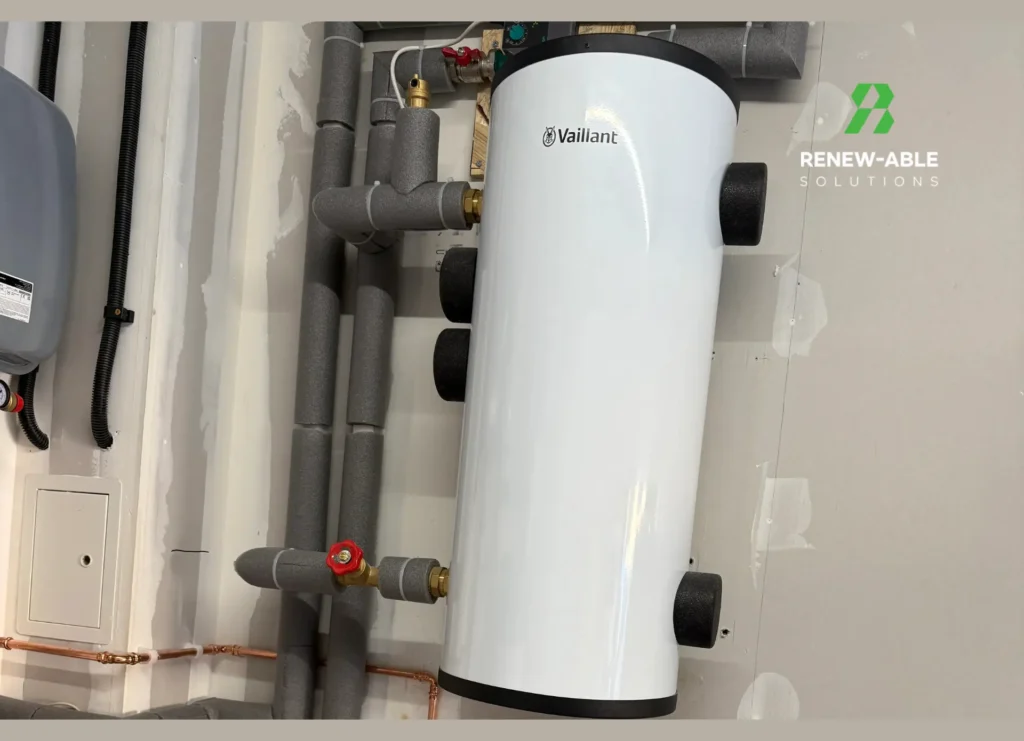
The outdoor unit may have an obvious place beside the house. The harder question can be indoors: where will the hot-water cylinder fit? Planning heat pump hot water early avoids choosing a system before its most practical details are clear.
Most conventional air-to-water heat-pump systems use a suitable cylinder for domestic hot water. Its size and position should reflect household demand, reheat performance and safe installation access. Bedroom count alone is not enough.
That is especially relevant when an Edinburgh or East Lothian home currently has a combi boiler and no stored hot water.
Want advice for your home? Call 0131 210 0405 or send an enquiry to Renew-Able Solutions.
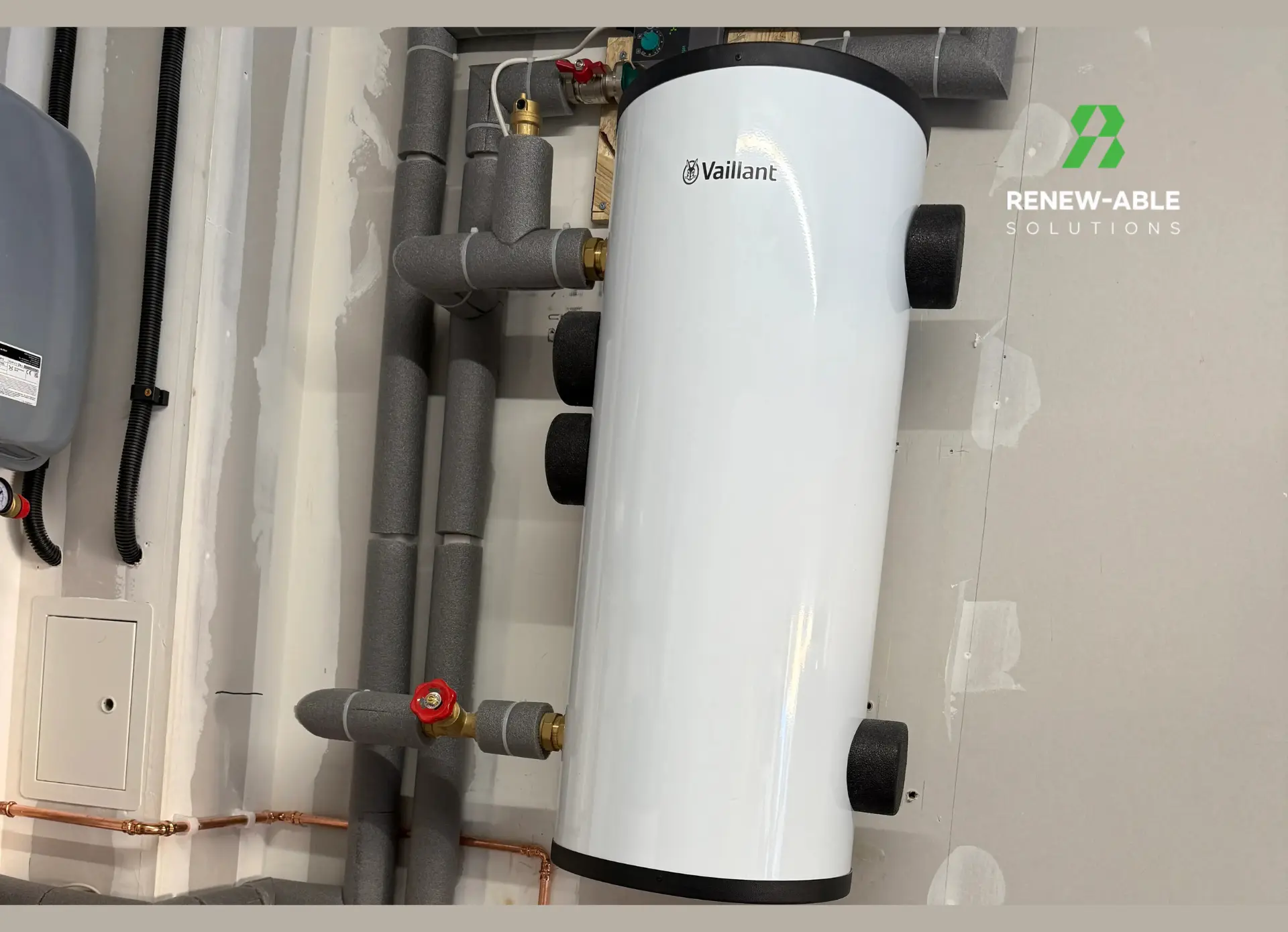
What does the cylinder actually do?
The cylinder stores heated water for taps, showers and baths. In a typical arrangement, the heat pump supplies heat through a suitable heat exchanger. The stored domestic water is distinct from the water circulating through radiators.
The Energy Saving Trust’s air-source heat-pump guide explains the main system arrangement. The precise equipment and controls vary, so ask for a diagram of your proposal.
A cylinder is also different from a heating buffer vessel. If a quotation lists both, ask what purpose each serves and why the design needs it.
Heat pump hot water: start with household demand
Two three-bedroom homes can use very different amounts of hot water. One household may take short showers at different times. Another may need two showers and a bath within a short evening period.
Tell the designer about the busiest normal period, not only the average day. Include any plans for another bathroom or a change in occupancy.
| Detail to discuss | Why it matters |
|---|---|
| Number and timing of showers | Several uses close together need enough stored capacity or timely reheating. |
| Bath size and frequency | A large bath can use a substantial amount of mixed water. |
| Incoming water and storage temperatures | They affect how much usable mixed water the cylinder provides. |
| Heat-pump reheat performance | It determines how quickly the store can recover. |
| Available location | It constrains dimensions, pipe routes and service access. |
Why litres alone can mislead
A cylinder’s nominal volume is not the same as a guaranteed number of showers. Usable hot water depends on the stored temperature, incoming cold-water temperature, mixing and how the system draws from the tank.
Consequently, compare proposals using the same assumptions. Ask the installer what morning or evening demand the selected cylinder is intended to meet.
Also request the expected reheat behaviour for the chosen heat pump and cylinder combination. A generic brochure recovery time may use different conditions from your design.
Can the existing cylinder provide heat pump hot water?
Possibly, but it needs a suitability check. A cylinder originally designed for a boiler may have a heat exchanger that does not suit the proposed heat pump. Age, condition, controls and insulation matter too.
Replacing it can improve compatibility, but there should be a clear reason in the scope. Conversely, retaining it purely to reduce the headline price can create a poor result if it cannot transfer heat effectively.
Ask whether the manufacturer approves the proposed combination and what performance assumptions the installer has used.
Measure the full installation space
A tank that fits through the cupboard door may still leave too little room for pipework, valves or maintenance. The designer should consider the access route and the finished installation, including future replacement.
Potential positions might include a suitable utility room, cupboard or another assessed space. A loft or garage is not automatically suitable: access, structural support, heat loss and the required pipework all need review.
For unvented arrangements, the designer must also consider the safety controls and discharge route. This is professional design work, not simply choosing an empty corner.
Plan controls without sacrificing comfort or hygiene
Hot-water schedules can sometimes make use of cheaper electricity or daytime solar. However, there must still be enough hot water when the household needs it.
Keep the system’s required hygiene cycle and manufacturer instructions intact. Do not lower settings or disable safety functions merely to chase a lower app figure. Ask the installer to explain normal operation, boost functions and any immersion use.
Our winter bills guide provides wider context. A lower tariff can reduce cost, while a suitable system design controls the energy needed in the first place.
Heat pump hot water: questions before accepting a quote
- Why does this capacity suit our busiest hot-water period?
- What cylinder model and heat exchanger are included?
- What space and access does the finished installation require?
- What pipework, electrical and making-good work is included?
- How will we use schedules, boost and holiday modes?
For older buildings, our older Scottish homes guide covers the wider suitability questions. You can also read our installation cost guide before comparing complete scopes.
A well-planned cylinder should fit both the building and daily life. Settling those details early is far easier than discovering a space or capacity problem after equipment has been ordered.
Talk through your next step
Tell us whether you have a combi boiler or a cylinder, how many people use hot water and where space is available. We can discuss the options.
Explore our heat-pump service, call 0131 210 0405 or submit an enquiry. Renew-Able Solutions serves Edinburgh, East Lothian and surrounding areas; tell us your postcode so we can confirm suitability and coverage.
Technical sources and examples checked on 3 October 2026. Illustrative figures are not quotations or guaranteed savings.