COMMERCIAL SOLAR CARE · SCOTLAND
Protect your people, your premises and the power your business depends on. Commercial electrical testing, internal infrared thermography and external drone surveys — with clear findings and practical next steps.
One-off inspections · Planned preventative maintenance · Systems installed by other contractors
A commercial solar installation is a long-term electrical asset, not a fit-and-forget addition to the roof. Weather, temperature cycling, contamination and electrical loading can gradually affect panels, connections, cabling and inverters.
The whole system does not have to stop for something to be wrong. An offline string, faulty optimiser or developing connection problem can go unnoticed while the rest of the array continues producing electricity.
Renew-Able Solutions combines commercial solar servicing, electrical inspection and testing, monitoring reviews and thermal imaging to identify developing problems and protect your investment.
Damaged insulation, water ingress, deteriorating connectors and loose terminations can create shock, overheating and arcing risks. Early investigation allows defects to be addressed before they develop into serious failures.
PV DC circuits can remain energised in daylight. Inspection and maintenance need competent personnel and appropriate safe systems of work.
Partial system faults may reduce output without an obvious shutdown. Reviewing alarms, operating readings and generation trends helps identify where electricity production is being lost.
Resolving confirmed defects can recover avoidable losses, reduce unplanned downtime and protect the return from your solar investment.
Blocked ventilation, contamination and abnormal heating can put unnecessary stress on equipment. Addressing their causes helps protect components and supports their useful working life.
A maintenance history also makes it easier to plan repairs and replacements. Servicing cannot prevent every failure or reverse normal ageing.
We agree an inspection and test schedule for your installation, taking account of system design, manufacturer instructions, previous findings, site operations and insurer requirements. The scope can include the following.
Accessible AC and DC cabling, connectors, isolators, protective devices, surge protection, earthing and bonding are checked for condition and suitability.
Depending on the agreed scope, electrical tests may include protective-conductor continuity, polarity, insulation resistance, suitable string voltage and current measurements, and verification of relevant protective measures. Results are recorded and compared with the installation design and previous readings where available.
Testing is adapted to the equipment. Inverters, optimisers, meters and other electronics must not be exposed to unsuitable test voltages. Intrusive inspection and tests requiring isolation are planned and performed using appropriate safe-isolation procedures.
We review inverter condition, ventilation, cooling, cable entries, operating data, active and historic alarms, and signs of contamination or water ingress.
With monitoring access, we can investigate offline equipment, optimiser communications and unusual generation patterns. Similar strings are compared under comparable sunlight and operating conditions, rather than assuming every difference indicates a fault.
Visual inspection looks for damaged modules, contamination, loose or displaced components, deteriorating cable support and other accessible defects. High-resolution drone imagery can help assess large or difficult-to-access arrays.
Physical roof access, fixing checks and access equipment are agreed separately where required. A drone survey cannot confirm the tightness of a fixing or inspect every concealed connection.
Where fitted and included in the scope, we check generation metering, export-limitation equipment, warning labels and emergency-shutdown arrangements.
Functional tests that could interrupt generation, affect site processes or operate a fire-alarm interface are agreed in advance. Following testing, we verify the agreed system operating state and record any remaining restrictions or defects.
A component can look normal while operating at an abnormal temperature. We combine internal electrical thermography with external aerial thermal imaging to investigate temperature patterns that a standard visual inspection may miss.
INTERNAL · HIKMICRO THERMOGRAPHY
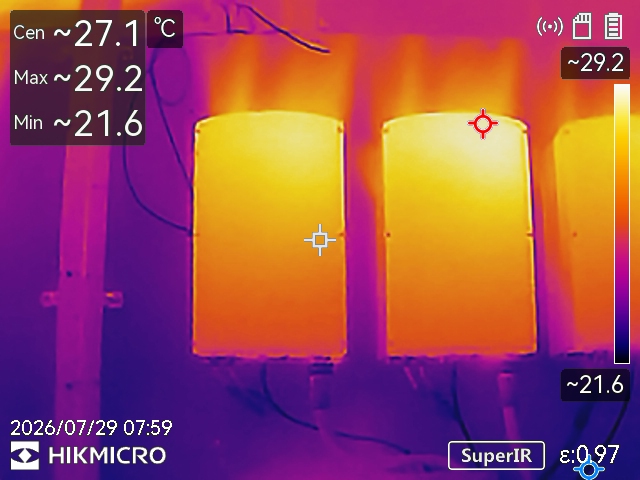
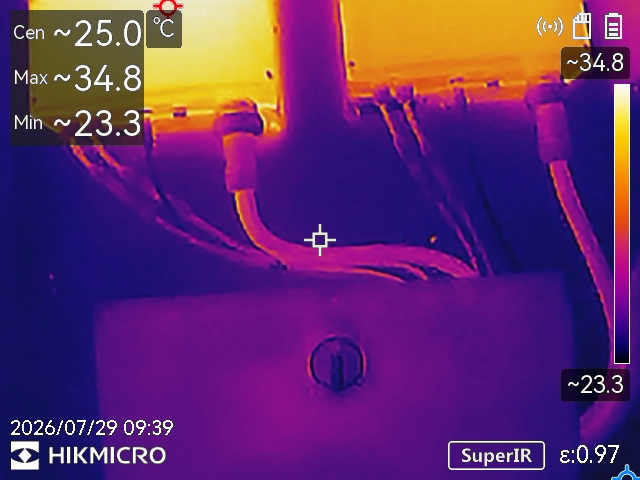
Using professional HIKMICRO thermal-imaging equipment, we assess accessible PV electrical equipment under suitable operating load, where this can be done safely.
This can include inverter connections, AC and DC isolators, switchgear, protective devices and terminations. Localised heating or differences between comparable phases and components can indicate a need for further investigation.
Thermal findings are assessed alongside electrical readings, load and ambient conditions. A warm component is not automatically faulty, and a thermal image alone does not prove the cause of an anomaly.
EXTERNAL · DRONE THERMAL SURVEYS
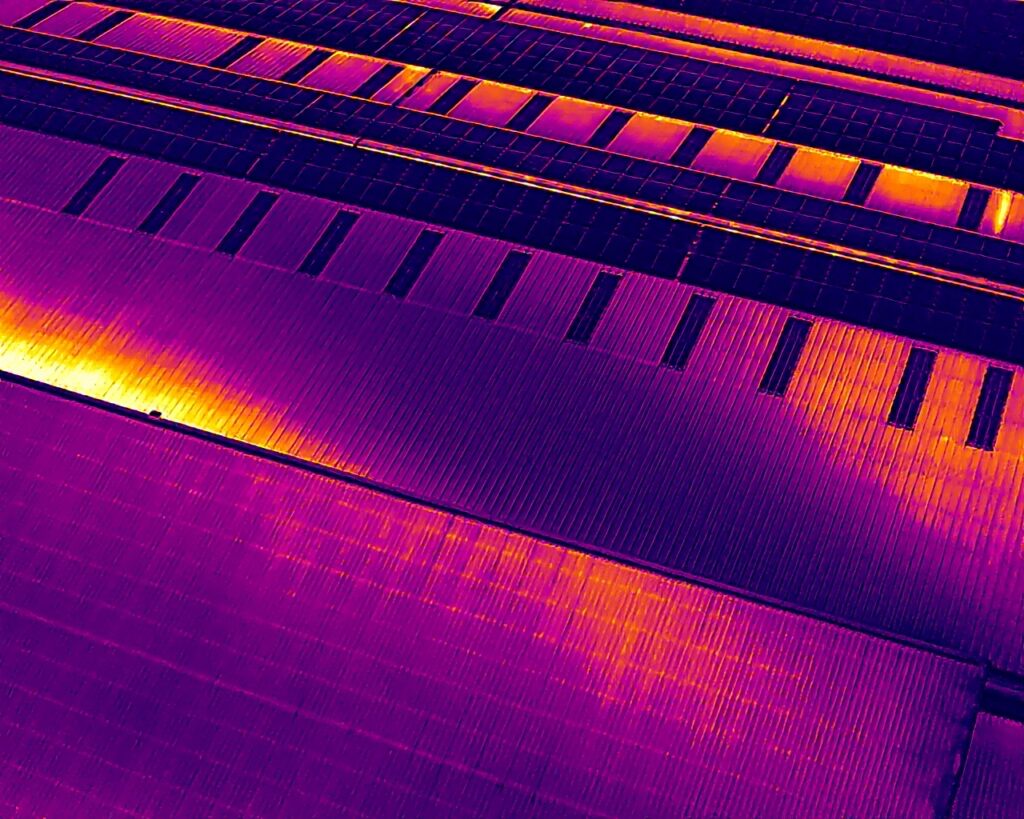
High-resolution visual imagery and radiometric thermal imaging allow larger commercial arrays to be assessed from the air.
We look for abnormal cell, module and string temperature patterns, including hotspots and patterns that may be associated with bypass-diode problems or sections not operating as expected. Findings are located and documented for follow-up.
Drone surveys can reduce initial roof access and help target subsequent inspections. Flights remain subject to site permissions, airspace requirements, safe operating conditions and an appropriate survey plan.
Useful data depends on the right conditions. Solar irradiance, system load, wind, cloud, viewing angle and reflections can affect results. We record relevant conditions and limitations. Thermal imaging complements electrical testing; it does not replace it or guarantee that every defect will be detected.
Commercial insurers may require evidence that electrical installations are being inspected and maintained. Some businesses are asked for inspection reports when arranging or renewing cover, or following a risk assessment.
Where inspection or maintenance is a condition of your policy, failing to meet it could affect cover or the handling of a claim. The required scope, frequency, qualifications and remedial deadlines depend on the insurer and the individual policy. Do not assume that a general building inspection automatically includes the solar PV installation.
We can help you assemble a clear record of the agreed PV inspection, electrical test results, thermal findings, limitations and recommended remedial work. Share your insurer’s requirements before booking so the proposed scope can be checked against them.
Always confirm acceptance with your insurer or broker. A maintenance report is supporting evidence, not a guarantee of insurance cover. Identified defects may also need to be rectified and documented.
Read Allianz’s guidance on electrical inspections and insurance requirements.
1. Establish the scope. We review system information, previous reports and monitoring access, then agree access arrangements, permits, site-specific risks and any planned shutdowns.
2. Inspect, test and survey. Electrical checks and thermal surveys are coordinated with the site team. Weather-dependent aerial work may need a separate suitable visit.
3. Explain the findings. You receive recorded results, photographs where included, prioritised observations and practical recommendations. Immediate safety concerns are escalated promptly.
4. Plan remedial work and follow-up. Repairs, replacement parts, cleaning and specialist access are quoted or agreed separately unless specifically included. Follow-up checks can document completed remedial work.
Your commercial solar maintenance report records the work actually completed, rather than presenting a generic checklist as proof of condition.
Retain the report with your asset records and document any subsequent repairs. This provides a useful baseline for future servicing, facilities management and insurer discussions.
An annual maintenance review is a useful starting point for many commercial systems, but there is no single interval suitable for every site. The programme should reflect manufacturer guidance, environmental exposure, previous defects, monitoring findings and insurer requirements. Some checks may need to be more frequent.
Yes. We can assess existing commercial PV installations, subject to suitable access and an agreed scope. This is particularly useful after a property purchase, where records are incomplete, or when the original installer no longer provides maintenance.
No. Thermography provides complementary information about surface temperature patterns. It cannot by itself verify insulation resistance, protective-conductor continuity or every aspect of electrical safety. A PV maintenance visit is not automatically a full Electrical Installation Condition Report for the building; the inspection boundaries and certification must be agreed.
We plan the work to limit disruption. Thermal surveys normally need useful operating load, while some electrical tests require safe isolation and a temporary interruption to generation. Any shutdown, fire-alarm interface test or process impact is agreed with your site team in advance.
Cleaning is assessed and quoted separately unless included in your agreed package. Correcting defects or significant soiling can recover avoidable generation losses, but an already healthy system may show little change. We do not promise a fixed percentage improvement or an extension to a manufacturer’s warranty.
Whether you need a one-off condition assessment, an investigation into underperformance or an ongoing planned preventative maintenance programme, speak to Renew-Able Solutions.
We support commercial property owners, industrial facilities, warehouses, agricultural businesses, schools, hospitality operators and facilities managers across Edinburgh, the Lothians and Central Scotland, with larger commercial projects considered throughout Scotland.
Tell us your site postcode, approximate PV capacity, inverter details and any insurer requirements. We will help define a suitable inspection and maintenance scope.
Planning a new installation or expansion? Explore our commercial solar installation service.
Further maintenance guidance: HSE: maintaining electrical equipment safely · Allianz: solar monitoring and maintenance.
Inspection scope, access arrangements and reporting are agreed for each site. Electrical testing and thermal imaging are complementary; neither guarantees a fault-free installation or insurance acceptance.

Renew-Able Solutions is a locally based renewable energy and heating company serving Edinburgh, East Lothian and wider Central and East Scotland. We design, install and service solar PV, battery storage, EV charging, air source and air-to-air heat pumps, commercial renewables and supporting heating systems.
Copyright © All rights reserved 2026: Renew-Able Solutions is a trading style of Valente Group Ltd T/a Renew-Able Solutions 4 Bankpark Grange, Tranent, East Lothian EH33 1ER T: 0131 210 0405