RENEW-ABLE SOLUTIONS · COMMERCIAL SOLAR CASE STUDY
Why an annual commercial solar service looks beyond the generation figures — and how a planned cleaning and biological-growth control programme can help protect long-term performance.
By Renew-Able Solutions · Commercial solar servicing team
Client and site details withheld.
The asset: an operational commercial rooftop solar PV installation.
The assignment: annual preventative maintenance and service inspection.
The approach: electrical checks, inverter and monitoring review, internal thermography and an external visual/thermal drone survey.
The proposed next stage: whole-array cleaning, with a suitable anti-mould and lichen-control treatment considered only after compatibility and use requirements are confirmed.
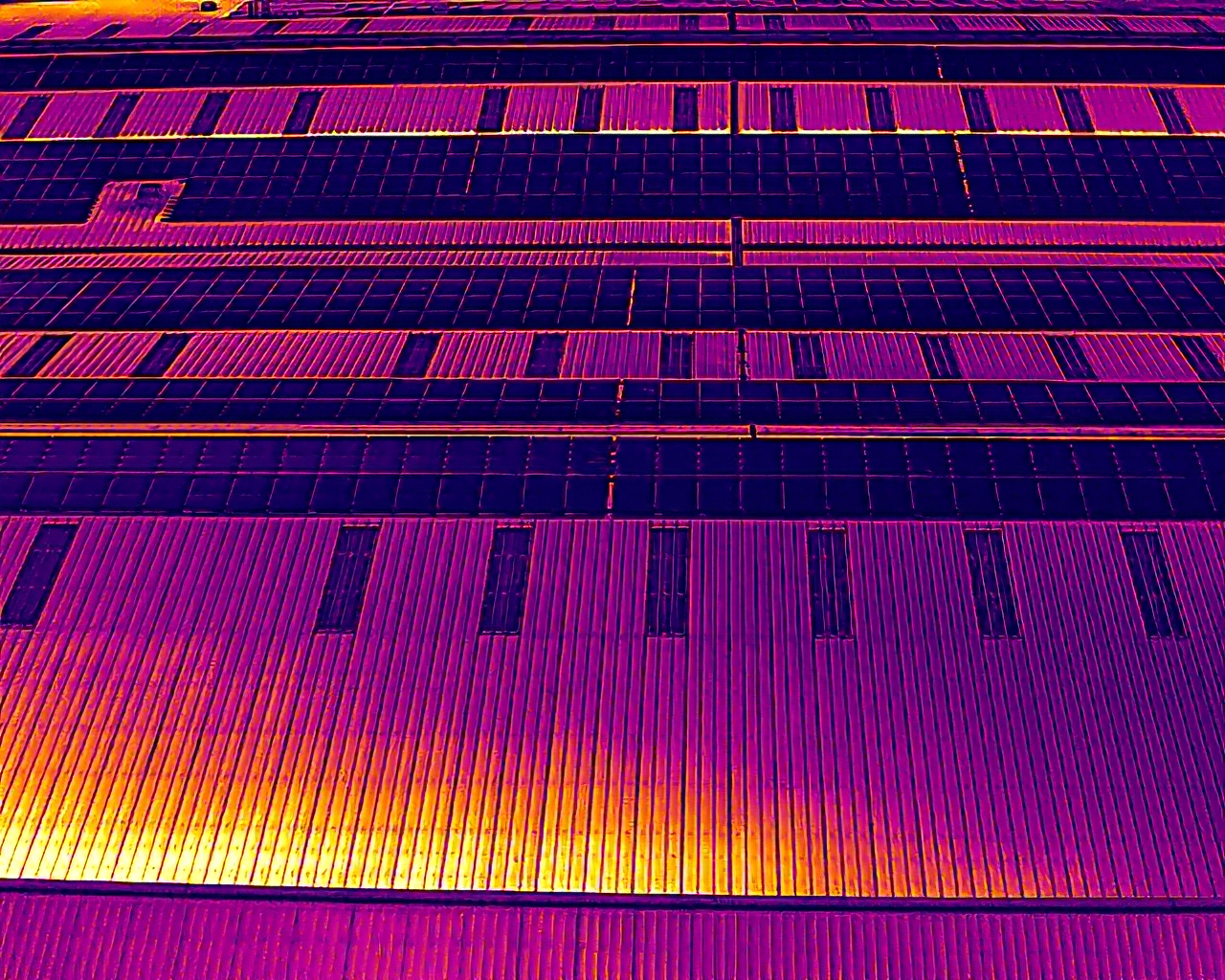
Aerial thermal inspection. We review temperature patterns across the modules alongside visual observations, monitoring information and electrical test results. The survey team reported normal panel temperatures during this inspection.
Renew-Able Solutions carried out an annual maintenance and service visit for a commercial solar PV system. The aim was to review the installation as an electrical asset: how it was operating, the condition of accessible equipment and whether anything needed closer investigation.
A generation total alone cannot answer those questions. Part of an array can underperform while the remaining equipment continues producing electricity. Equally, a system can be generating normally while a connection, enclosure or cooling arrangement begins to deteriorate.
Our maintenance approach therefore combined operating information with physical inspection, appropriate electrical testing and thermal imaging. It is the same principle behind our commercial solar PV servicing and maintenance service: establish the condition of the system before a developing issue becomes a disruptive failure.
The electrical inspection was structured around accessible AC and DC equipment, inverter connections, isolation, cable routes, protection, earthing and bonding. Inverter condition, ventilation, operating information and monitoring communications were also part of the review.
The reason is practical. Damaged cabling, moisture ingress, deterioration and poor connections can affect reliability and create electrical risks. Monitoring and alarm histories add context: they can reveal intermittent problems that are not obvious during a short observation on site.
Electrical test methods must suit the installed equipment. Protective-conductor continuity, insulation testing and string measurements are not interchangeable checks, and some require isolation or disconnection of sensitive electronics. Inverters, optimisers and surge-protection equipment must not be exposed to unsuitable test voltages.
For this reason, the case study does not reproduce a generic test list as though every test applied or every result passed. The scope, recorded readings and any limitations belong in the service report. Our objective was a useful condition assessment, not simply a tick against “solar panels checked”.
Background: HSE guidance on maintaining electrical equipment safely.
Internal thermography complemented the electrical checks. HIKMICRO thermal-imaging equipment allows accessible components to be assessed for surface-temperature patterns while operating under suitable load, where the inspection can be carried out safely.
This matters because an electrical connection may appear normal in a conventional photograph but show unusual localised heating in a thermogram. Comparing similar components and phases can help identify where further investigation is worthwhile.
A thermal image is evidence to interpret, not a diagnosis on its own. Load, ambient temperature, emissivity and reflections affect the result. An apparent hotspot needs to be considered alongside the equipment and electrical readings; a warm component is not automatically defective.
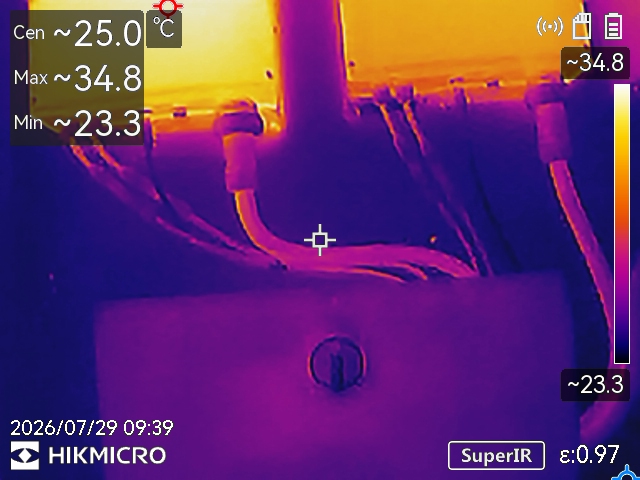
Cables and connections under load. We recorded the thermal pattern around the inverter connections and DC cables and assessed it alongside our test-instrument readings. No thermal or instrument-test anomalies were reported during these checks.
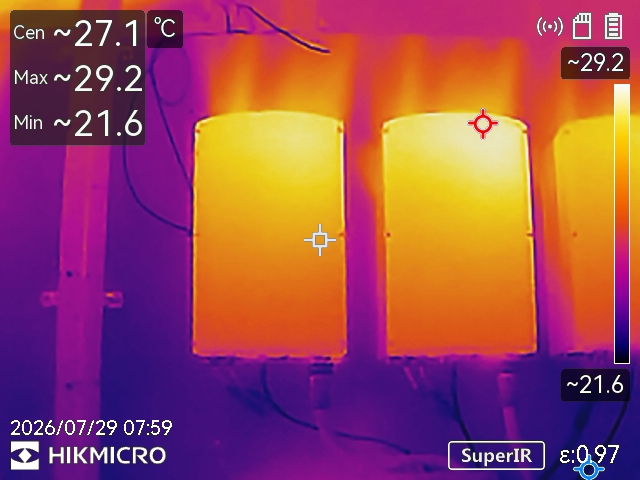
Inverter operating temperatures. The thermogram records surface temperatures while the equipment is working. All inverters were reported to be operating normally; the thermal survey and test instruments identified no anomalies in the inverter and DC cable checks.
The external survey combined aerial visual imagery with radiometric thermal imaging. This provided a way to inspect roof-mounted modules without treating routine access to the whole roof as the starting point.
Visible-light imagery helps locate modules and assess exposed condition. Thermal imagery adds information about differences between cells, modules and sections of the array. Used together, they help engineers identify areas requiring more detailed checks.
The survey depends on suitable irradiance, weather, viewing angle and operating conditions. It cannot verify the tightness of a fixing or the condition of every concealed connector. Its value is in screening the accessible array and helping target further investigation—not replacing hands-on electrical testing.
We assess thermal images alongside conventional photographs and monitoring records. This helps distinguish module temperature patterns from the surrounding roof and locate areas for follow-up. A normal-looking thermogram does not resolve a non-reporting optimiser or confirm the condition of every concealed connection.
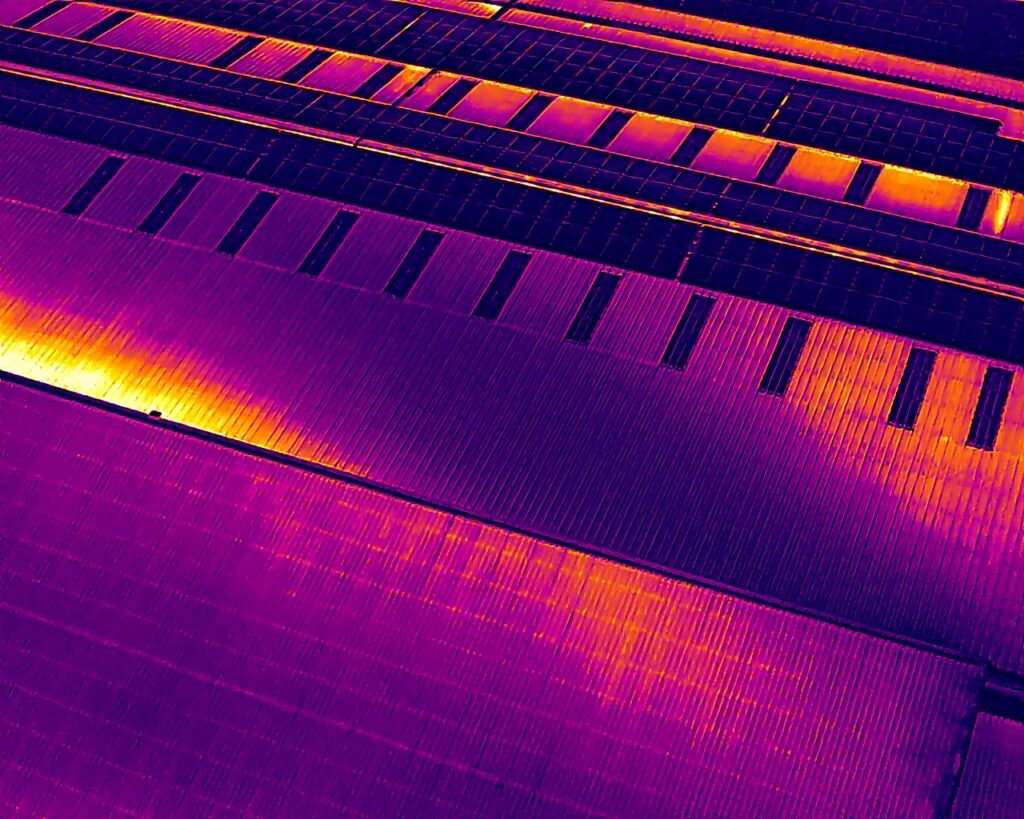
Module temperature patterns. Aerial thermography helps screen the array for areas needing closer investigation. Roof materials, viewing angle and reflections affect the colours, so the image is interpreted alongside operating conditions and other checks. Monitoring issues can still require follow-up even when panel temperatures appear normal.
Cleaning and any biological-growth treatment are proposed follow-on activities, not work recorded as completed during this service visit.
Electrical maintenance and panel cleaning solve different problems. Testing assesses the electrical system; cleaning addresses material on the glass that can obstruct sunlight. Dust, deposits, bird fouling and biological growth can reduce the light reaching the cells. Rain may remove loose dirt, but it does not reliably remove every adherent deposit.
The proposed approach is to clean all panels within the agreed array rather than only the most accessible or visibly dirty sections. This gives the maintenance team a consistent cleaned baseline and avoids leaving untreated patches that may continue to obstruct light. The value of doing so should still be judged against actual soiling, safe access and the cost of the work.
Cleaning would use a module-compatible process, suitable water quality and non-damaging equipment. The plan needs to account for damaged modules, surface coatings, water temperature, electrical hazards, roof access and drainage. Scraping, aggressive chemicals or an unsuitable pressure-washing process can create damage rather than solve a maintenance problem.
Where stubborn lichen or other growth is present, its removal may need a specifically approved method. It should not simply be forced off the glass. Specialist product guidance distinguishes removal of adherent growth from measures intended to reduce recurrence; the correct choice still depends on the module and the proposed product.
Background: Allianz on solar monitoring, maintenance and the effect of soiling.
Removing visible deposits does not mean an outdoor surface can never be recolonised. Where biological growth is a recurring issue, a suitable treatment may form part of a longer-term panel-care plan.
The proposed sequence is to remove the contamination using an approved cleaning method, then assess whether a compatible post-clean treatment offers a justified benefit. A treatment intended to inhibit growth aims to reduce the rate of recurrence and help keep the glass clear between visits. That claim must be supported by the selected product: a lichen-removal cleaner is not automatically a residual growth inhibitor.
Any treatment must be suitable for the particular modules, including their glass coating, seals and frames, and permitted for the intended use. A product suitable for roof tiles is not automatically suitable for solar panels. Label instructions, application sequence, contact time, rinsing requirements, COSHH controls and runoff management must be followed. We would not assume that leaving a chemical film on the glass is acceptable.
No treatment is being specified by name for this project at this stage, and no duration of regrowth protection is promised. The aim is to reduce avoidable biological fouling where a suitable treatment is justified—not guarantee permanently growth-free panels.
Product use and environmental controls: HSE guidance on choosing and using biocides.
The purpose of combining servicing and panel care is to remove avoidable restrictions on performance: electrical faults, cooling problems and surface contamination each need the appropriate response.
Maintaining clean glass can help available sunlight reach the cells. Resolving confirmed electrical defects can recover associated generation losses. Addressing causes of overheating and deterioration can also support equipment reliability and useful service life.
“Optimum” means getting the best practical performance from the existing installation in its actual conditions. It does not mean the array will always produce its nameplate power, that normal ageing is reversed or that every clean delivers the same gain.
This case study does not claim a measured percentage increase, financial saving or extended warranty. A meaningful before-and-after comparison would need generation data assessed against irradiance, temperature, downtime and other operating conditions—not simply two readings taken on different days.
The value of the annual visit was the joined-up approach: use monitoring information, inspect the equipment, test appropriately and add thermal evidence where useful. The next maintenance decisions can then be based on condition rather than guesswork.
Cleaning and growth control belong within that wider plan, with their own scope and safety arrangements. Service records, recommendations and completed remedial work should be retained together so future inspections have a useful baseline.
Businesses should also check the PV inspection requirements in their insurance arrangements with their broker or insurer. A service report can support those discussions, but it does not by itself guarantee cover or replace outstanding remedial work.
For help planning ongoing expenditure, read our guide to commercial solar maintenance budgets.
Generation alone does not establish electrical condition. Partial underperformance, deteriorating connections or cooling problems may need investigation even when the system remains online.
They examine different parts of the installation. Handheld thermography supports accessible electrical-equipment checks; aerial thermography assesses patterns across roof-mounted modules. Both complement, rather than replace, electrical testing.
No permanent protection should be assumed. A compatible product may help control existing growth or inhibit recurrence where those uses are supported by its instructions. Removal and residual protection are different claims, and ongoing inspection is still needed.
Cleaning can recover losses caused by soiling, but the benefit depends on how dirty the panels are and how the system operates. It cannot correct unrelated inverter faults, unsuitable design or shading from surrounding structures.
Renew-Able Solutions provides commercial solar inspection and maintenance support across Edinburgh, the Lothians and Central Scotland, with larger commercial projects considered throughout Scotland. This describes our service coverage, not the location of the client in this case study.
Whether your system needs a one-off assessment, investigation of underperformance or a planned annual service, we can help define a suitable scope—including electrical checks, internal thermography and aerial inspection where appropriate.
Commercial solar PV design and installation
Planning a new system, extension or upgrade.
Solar panels for warehouses and industrial buildings
Considerations for larger commercial rooftops.
Commercial solar in Edinburgh and East Lothian
Our regional commercial installation service.
What businesses should budget for solar maintenance
Planning for servicing, inspection and ongoing asset care.
The external references linked in this article provide general maintenance and product-use context. They are not the client’s inspection report or evidence that a particular chemical treatment was selected or applied. Exact test findings and client-identifying details are deliberately not reproduced.

Renew-Able Solutions is a locally based renewable energy and heating company serving Edinburgh, East Lothian and wider Central and East Scotland. We design, install and service solar PV, battery storage, EV charging, air source and air-to-air heat pumps, commercial renewables and supporting heating systems.
Copyright © All rights reserved 2026: Renew-Able Solutions is a trading style of Valente Group Ltd T/a Renew-Able Solutions 4 Bankpark Grange, Tranent, East Lothian EH33 1ER T: 0131 210 0405