Commercial solar in Scotland / Sigenergy SigenStack
Store more of your solar energy. Control when your business uses it.
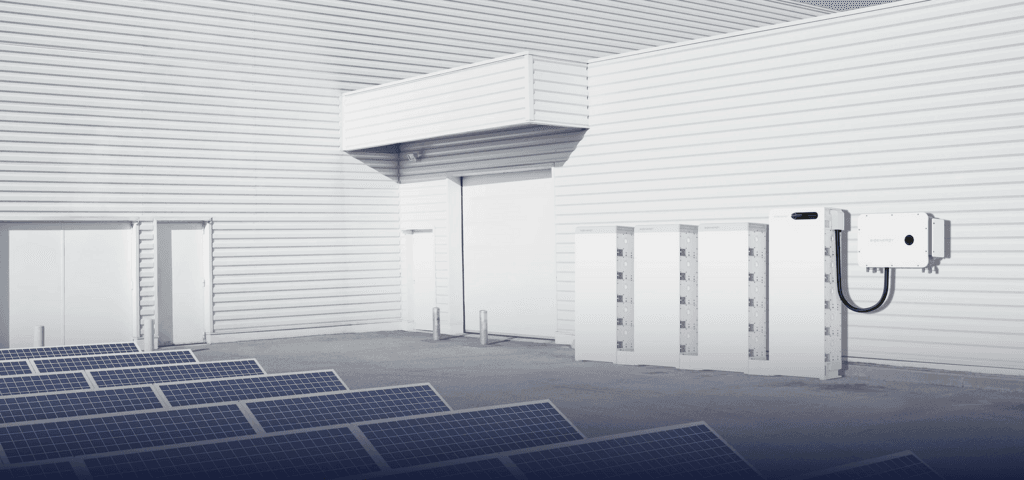
Sigenergy SigenStack is a modular battery energy storage system for commercial and industrial sites. Renew-Able Solutions can assess it alongside commercial solar for businesses in Edinburgh, East Lothian and wider Scotland, from workshops and farms to warehouses and larger premises.
This guide explains battery capacity, power output, expansion and backup, then shows how we turn your electricity data into a practical project brief.
Explore: Battery capacities · Power and runtime · Business applications · Backup power · Design and costs · FAQs
A commercial battery shifts electricity from the time it is available to the time your business needs it. Solar can supply daytime loads first. A compatible control strategy can then store surplus generation and discharge it later, reducing the amount bought from the grid during those periods.
SigenStack brings together modular batteries, battery controllers and a compatible Sigen commercial hybrid inverter. In a DC-coupled solar design, solar and storage share the inverter. The site still needs metering, protection, distribution equipment and an agreed grid connection.
A battery is useful when it solves a measured problem. Start with our guide to whether commercial solar needs battery storage if you are comparing solar-only and solar-plus-storage proposals.
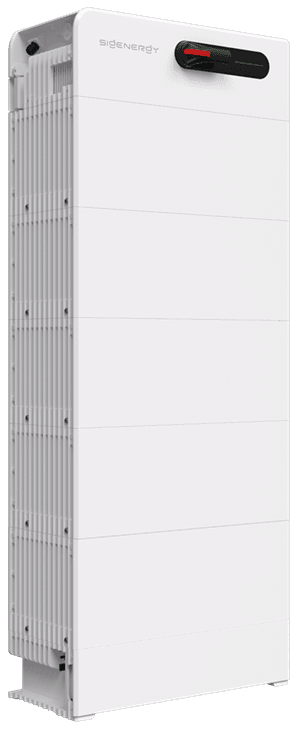
The SigenStack BAT 12.0 module contains 12.06 kWh of total energy. Sigenergy’s February 2026 battery datasheet specifies 4–21 modules per system, with up to seven in one stack. The figures below are total nameplate energy, calculated from the module rating.
| Modules | Total energy | Illustrative layout |
|---|---|---|
| 4 | 48.24 kWh | One stack |
| 5 | 60.30 kWh | One stack |
| 6 | 72.36 kWh | One stack |
| 7 | 84.42 kWh | One full stack |
| 14 | 168.84 kWh | Two full stacks |
| 21 | 253.26 kWh | Three full stacks |
These are sizing examples, not universal equipment combinations. The inverter, controller, wiring arrangement and product revision determine which layout is permitted. Source: Sigenergy SigenStack BAT 12.0 and BC datasheet, version 20260224.
The energy delivered to your equipment will be lower than the nameplate total. We allow for the operating state-of-charge window, any backup reserve, conversion losses, temperature and battery ageing. A proposal should therefore state both installed capacity and the usable energy assumed in its calculations.
For example, a business with an 84.42 kWh stack should not assume it can receive 84.42 kWh at its sockets every cycle. Reserving energy for an outage also leaves less available for routine tariff savings.
Yes, larger projects can coordinate multiple compatible systems. As an illustration of scale, four systems each containing 21 modules total 1,013.04 kWh, or about 1.01 MWh, before usable-energy allowances. This is arithmetic for early planning, rather than a ready-to-install design.
Sigenergy’s published gateway range includes the C600-B with up to 10 hybrid inverter inputs and a listed maximum storage capacity of 2,530 kWh. Its C1200-B lists up to 20 inputs and 5,060 kWh. These are manufacturer system limits, not the output or storage guaranteed at a particular site. We confirm UK equipment availability, the approved combination and the site connection before specifying a project. See Sigenergy’s Business Energy Gateway specifications.
kWh tells you how much energy is stored. kW tells you how quickly it can be delivered. A large battery with a smaller inverter can support a modest load for longer, but it cannot necessarily start a large motor or supply every load at once.
Sigenergy’s published 50–110 kW hybrid inverter datasheet lists nominal AC outputs of 50, 60, 80, 100 and 110 kW. The document is marked preliminary, so the quote must identify the final UK model and ratings. Actual battery power also depends on the battery quantity, controller, state of charge and operating conditions.
That inverter document includes additional solar-string voltage requirements when 19–21 battery modules are used. This is one reason we check the whole solar-and-storage design before recommending the largest configuration. Source: Sigenergy hybrid inverter datasheet and configuration notes.
If a design provides 100 kWh of usable AC energy and the supported load averages 25 kW, the planning estimate is 100 ÷ 25 = four hours. At a steady 50 kW, the same energy lasts about two hours, provided the system can deliver that power.
This example uses an assumed usable-energy figure; it is not a runtime claim for a named SigenStack package. Real loads vary, and a reserve, weather, starting currents or changing temperature can shorten the available duration. For backup, we model the equipment that actually needs to remain running.
A workshop may produce surplus solar at lunchtime but still buy electricity late in the afternoon. Storage can move some of that surplus into the later period. However, a site that already uses nearly all its solar as it is generated may gain less from an additional battery.
Battery discharge can support site loads during defined peaks. For example, it may help when several machines operate together or fleet chargers overlap with other demand. We check the peak’s size, duration and frequency. A short, high-power peak needs a different design from a long evening load.
Where the equipment, tariff and connection allow it, charging from the grid during cheaper periods may reduce later imports at higher rates. The price difference must cover energy losses and operating costs. We also account for export income forgone when solar energy is stored instead of exported.
Storage can form part of an energy plan for refrigeration, heat pumps, machinery or commercial EV charging. Controls need clear priorities so that charging the battery does not create an unwanted import peak. A battery also cannot remove a network restriction simply by being installed.
See our sector guides for warehouses and industrial buildings and farms and agricultural buildings in Scotland.
Yes, with a compatible and correctly designed backup system. Batteries alone do not establish backup operation. The project needs the appropriate gateway, switching, protection, earthing arrangements and an agreed set of supported loads.
Sigenergy describes coordinated gateway, hybrid inverter and SigenStack systems with load-side switching performance of 0 ms under its stated conditions. This is a manufacturer performance claim, not a blanket promise that every business process will continue without interruption. We assess the intended loads and specify commissioning tests.
A useful backup brief identifies essential circuits, required running time, motor starting requirements and what can be shed. For example, preserving refrigeration and communications may be more practical than backing up all workshop machinery and EV chargers. Generator integration is also possible within supported gateway designs. See Sigenergy’s gateway and backup overview.
SigenStack uses lithium iron phosphate batteries and a floor-standing modular design. The published specification includes IP66 protection and smart air cooling. Sigenergy describes pack-level smoke and temperature detection, insulation, pressure relief and fire suppression. These features support the engineered system; the location still needs a site-specific assessment.
We review access, clearances, base loading, weather exposure, flood risk, vehicle impact, neighbouring activities and the building’s fire strategy. The location must also allow safe installation and future servicing. A narrow equipment footprint does not represent the whole space needed around the installation.
SigenCloud provides system monitoring. At handover, agree who receives alerts, who can change settings, how connectivity is maintained and what support is included. Build routine site checks and the applicable maintenance requirements into the operating plan. See Sigenergy’s SigenStack product overview and our commercial solar maintenance guide.
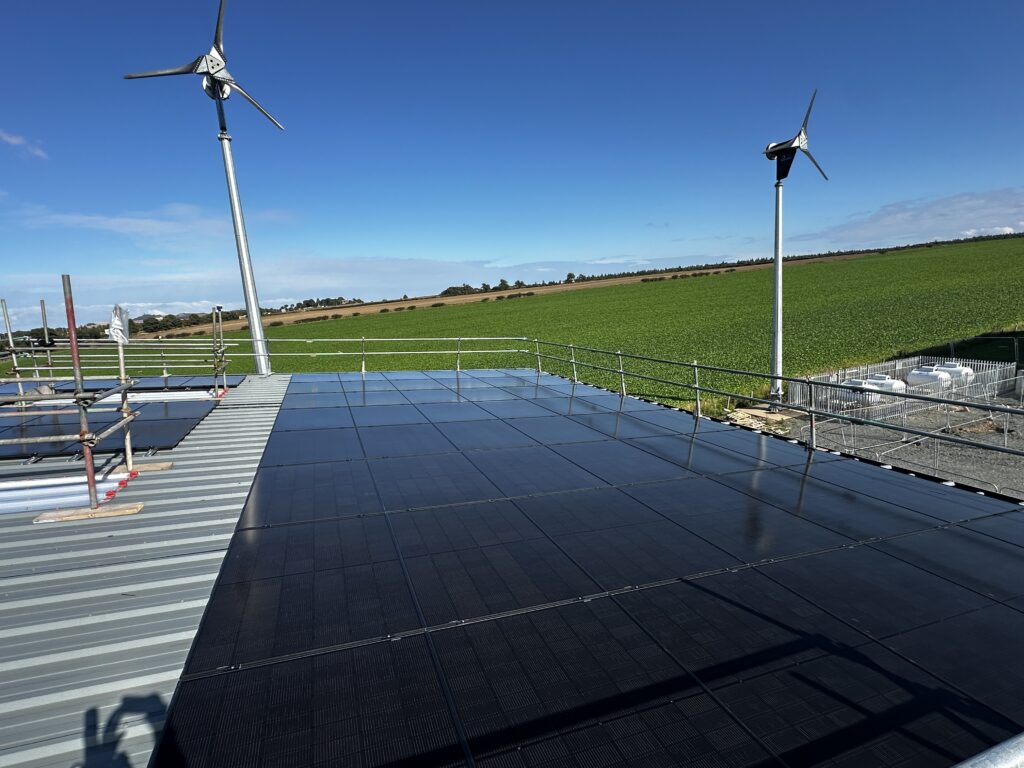
Our 143kWp integrated commercial energy case study combines rooftop solar, 80 kWh of battery storage and wind generation. Explore the project photography and installation video to see how several technologies can work within one site plan.
This is an example of our commercial energy work. The gallery photograph is not presented as a SigenStack installation, and its equipment or results do not define the design for your premises.
Start with the job the battery must do, then choose the equipment. We review half-hourly electricity data across a representative year, operating hours, seasonal demand, solar generation and the proposed control strategy. Read how half-hourly data helps size commercial solar for the information to request from your supplier.
A useful appraisal compares solar only, solar with a smaller battery and solar with a larger battery. It should explain annual energy flows, usable capacity, power limits, cycling, losses, tariff assumptions and any backup reserve. Buying more storage does not automatically produce a better return.
Module count is only part of the budget. Inverters, controllers, gateway equipment, protection, metering, cabling, access, base works, distribution-board changes and network requirements can all affect the installed price. Backup requirements and difficult cable routes can also change the scope.
We prepare a site-specific proposal rather than a headline battery price. It should separate equipment and installation costs, expected maintenance, warranty terms and the assumptions behind any savings estimate. See commercial solar costs in Scotland and commercial solar PPA considerations when comparing ownership and funding options.
Commercial solar and storage must follow the relevant network connection process. The DNO needs to consider both generation and battery behaviour. An export limit does not automatically permit a larger installation, and adding batteries to an existing system may require the connection agreement to be reviewed. Energy Networks Association guidance explains how electricity storage fits within the connection framework.
Our guides explain commercial solar planning and G99 and G100 export limitation. We confirm the proposed equipment and control arrangement against your site’s requirements.
No. SigenStack is Sigenergy’s modular commercial and industrial battery platform. SigenStor is a different product family. Their components and limits should not be treated as interchangeable. For home energy and bidirectional EV charging, read our Sigenergy vehicle-to-load and vehicle-to-home guide.
It may be possible, but the existing inverter, metering, connection agreement and electrical layout determine the approach. We compare a compatible retrofit arrangement with any equipment replacement needed. Existing PV does not by itself confirm compatibility.
Expansion can be planned within supported system limits. Allow space, electrical capacity and an appropriate control arrangement from the outset. Future modules, firmware, warranty conditions and compatibility must be checked when the expansion is proposed.
Runtime depends on usable energy divided by average supported load, subject to power limits and operating conditions. Provide an essential-load list and the required duration so we can model a suitable backup arrangement.
It can reduce selected grid imports, but savings depend on how the system is used. Solar surplus, tariffs, losses, export value and installation costs all matter. We model the business case using site data and stated assumptions.
The price depends on the battery capacity, inverter power, backup scope and site works. Send your postcode, bills and supply details for an initial review. A survey and equipment schedule are needed for a firm installed quotation.
Tell us your site postcode, business type, annual electricity use, operating hours and existing solar details. Include half-hourly data where available, your current tariff and any plans for EV charging, heat pumps or new machinery. If backup matters, list the essential equipment and the duration you need.
From our base in Tranent, East Lothian, we assess suitable commercial projects across Edinburgh and wider Scotland. We will explain the next survey or design stage and the information required for a project-specific proposal.
Call 0131 210 0405 or email hello@renew-able.co.uk. Return to commercial solar installation in Scotland.
Technical sources checked 9 September 2026. Published product limits vary by model, region and revision; the final equipment schedule and current manufacturer documentation govern each design. Manufacturer imagery: Sigenergy. Project photography: Renew-Able Solutions.

Renew-Able Solutions is a locally based renewable energy and heating company serving Edinburgh, East Lothian and wider Central and East Scotland. We design, install and service solar PV, battery storage, EV charging, air source and air-to-air heat pumps, commercial renewables and supporting heating systems.
Copyright © All rights reserved 2026: Renew-Able Solutions is a trading style of Valente Group Ltd T/a Renew-Able Solutions 4 Bankpark Grange, Tranent, East Lothian EH33 1ER T: 0131 210 0405