
SIGENERGY DC CHARGER INSTALLATION · EDINBURGH & EAST LOTHIAN
Your electric car can be more than transport. Vehicle-to-load (V2L) powers individual appliances; vehicle-to-home (V2H), also called vehicle-to-house, supplies a property through a compatible, professionally designed energy system.
Renew-Able Solutions installs the Sigenergy 12kW and 25kW DC charging modules in Edinburgh, East Lothian and wider Central and East Scotland. We help you assess charging, solar integration and the potential for V2H around your exact vehicle and home.
The 12kW model is specified by Sigenergy at up to 12.5kW. Bidirectional operation depends on the vehicle, software, system configuration and applicable approvals; installing a DC charger alone does not establish V2H compatibility.
How does Sigenergy DC compare with a conventional home charger? Compare its system requirements with Ohme, Andersen, Simpson & Partners, zappi and Hypervolt before choosing AC or DC charging.
On this page: V2L and V2H explained · 12kW vs 25kW · Vehicle checks · Solar and backup · Installation and cost · FAQs
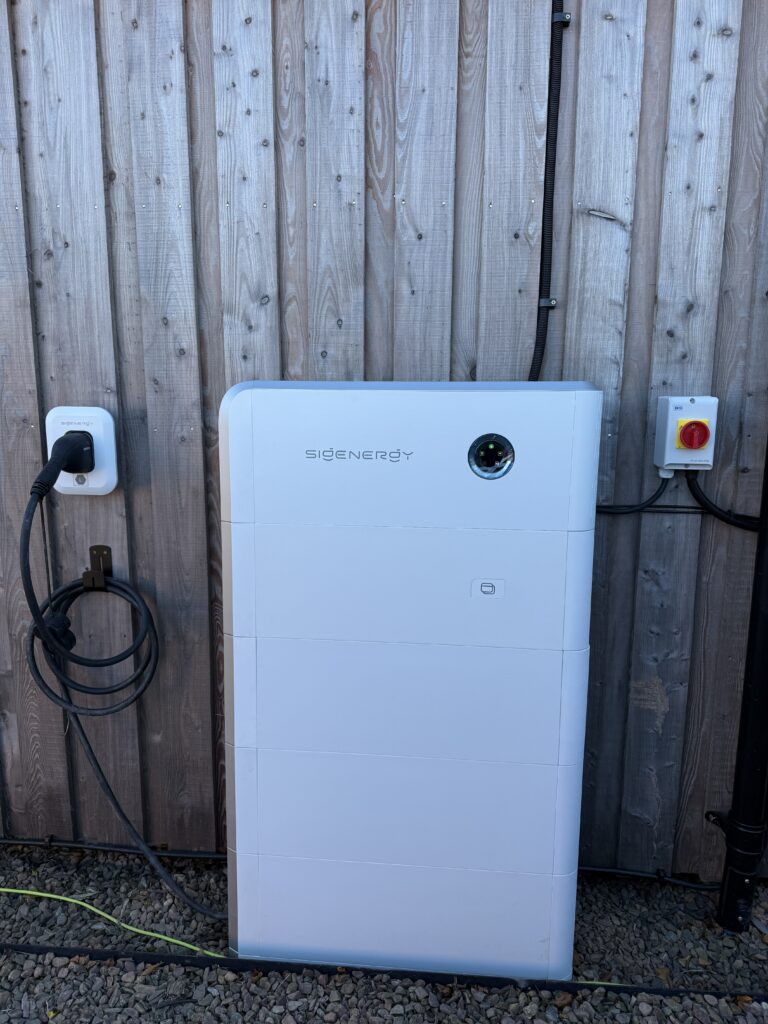
This Sigenergy SigenStor system and DC EV charging equipment were installed by Renew-Able Solutions for a customer. The modular arrangement brings home energy storage and EV charging together in one installation.
For your property, we specify the charger rating, energy controller, battery capacity, cable arrangement and any backup equipment in a written quotation. The installation shown is an example of our work; your design will reflect your vehicle, electrical supply and energy needs.
V2L lets a suitably equipped electric car supply electricity through a vehicle socket or manufacturer-approved adapter. Typical uses include charging a laptop, running camping equipment or powering suitable tools within the vehicle’s output limit.
The car’s own equipment produces the AC supply. A Sigenergy DC charger is not required for ordinary V2L use. Check the vehicle manual for the permitted adapter, continuous output, starting-load limits and minimum battery level. For example, Hyundai describes up to 3.6kW V2L on eligible INSTER specifications; this is not a universal rating for electric cars.
V2H uses energy from a compatible EV battery to supply home circuits through a suitable bidirectional charging and home energy system. With the right design, it can support household consumption while the car is connected and help provide backup during a power cut.
V2L capability, a CCS2 socket and ordinary DC charging each tell you something different about a car. None, by itself, confirms that the car can discharge through a Sigenergy system. We establish the intended V2H function before specifying the equipment.
V2G sends energy from an EV back to the public electricity network. It introduces export permissions, metering and supplier or tariff requirements in addition to compatible hardware. V2H does not automatically include a paid V2G service.
Never connect a vehicle’s V2L output to a household wall socket to feed the house. Supplying fixed wiring needs a properly designed connection, protection and isolation arrangement installed by a competent electrician. An extension lead used for an appliance is not a home-backup installation.
The Sigen EV DC Charging Module forms part of the Sigenergy system and must be used with a Sigen Energy Controller. It uses a CCS2 charging connection. Unlike a typical AC wallbox, DC charging supplies the vehicle’s battery through its DC charging path, rather than relying on the car’s AC onboard charger.
The model named SigenStor EVDC 12, commonly described as the 12kW charger, has a manufacturer-specified maximum charging and discharging port power of 12.5kW. It may suit households seeking faster home charging where the complete system and vehicle can support it.
The SigenStor EVDC 25 has a manufacturer-specified maximum charging and discharging port power of 25kW. It can be worth assessing for larger daily energy requirements or shorter periods parked at home. Choosing the higher-rated module does not guarantee that the car will charge, or the house will receive power, at 25kW.
Both models use a 150–1,000V operating range. Sigenergy lists maximum operating currents of 40A and 80A respectively, IP66 protection and integrated cable options. We confirm the supplied variant and cable reach when quoting. Read Sigenergy’s EVDC 12/25 specification.
The useful rate is limited by the vehicle’s accepted power and battery voltage, state of charge, temperature, available grid import, energy controller, solar generation and any battery contribution. The charger’s DC rating is also different from the home system’s AC output rating.
Illustrative charging calculation: adding 30kWh at a steady 12.5kW takes 2 hours 24 minutes; at a steady 25kW it takes 1 hour 12 minutes. These are energy-divided-by-power examples, not promised charging times. Allow for conversion losses, power limits and the car reducing its charging rate.
We assess single-phase or three-phase supply and available system power together. A 25kW DC module is not a promise of 25kW drawn continuously from a single-phase grid connection.
We check the exact vehicle before recommending V2H. Make, model, model year, market specification and software version all matter. Sigenergy publishes independent V2X field-test results; a test on a similar car is useful evidence, but it is not the same as vehicle-manufacturer approval or a guarantee for every variant.
View Sigenergy’s DC charger information and V2X field-test results. The manufacturer explains the limitations of these results, including variation by software and region.
For a useful assessment, send us:
We then check the proposed equipment combination, current manufacturer guidance, vehicle warranty conditions and any limits on discharge power or battery reserve. Where a function cannot be confirmed, your quotation should distinguish supported charging from any unconfirmed bidirectional capability.

Sigenergy offers PV-surplus and battery-boost charging modes, with settings to manage priorities and reserves. A joined-up design considers when you generate electricity, when your car is parked and how much energy your home needs. Solar generation varies through the year, so a system should also work sensibly on low-generation days.
Explore our solar PV installation service and home battery storage options alongside EV charging.
Power-cut backup needs a suitable gateway or changeover arrangement and a system designed to isolate safely from the public network. We assess the required Sigenergy gateway, protection, earthing and the circuits to be backed up, following the current manufacturer design requirements.
Lighting, refrigeration and communications may call for a different design from running an electric shower, cooker or heat pump. Starting currents and simultaneous loads matter. The car must be connected, have usable charge above its reserve and support the required discharge mode.
Runtime depends on usable energy allocated to the house and the average load. As a simple illustration, allocating 20kWh to home use gives 10 hours at a constant 2kW load before conversion losses and other limits. A large battery capacity does not mean that all of it is available, or that every appliance can run at once.
A home battery can still be valuable when the car is away. We plan the household battery reserve and the EV’s driving reserve together, so the energy strategy reflects how you use both.
Renew-Able Solutions is based in Tranent and serves Edinburgh, East Lothian and wider Central and East Scotland. We install both Sigenergy DC charger sizes and assess the complete home energy arrangement before recommending a specification.
UK grid-connected generation and storage can fall within G98/G99 requirements, with export limitation considered where relevant. V2G needs the applicable network agreement before operation. We establish the route for your design rather than assuming that a charger purchase grants export permission. ENA’s G99 engineering recommendation includes vehicle-to-grid requirements; the current DNO requirements govern the application.
We provide a property-specific quotation. The total depends on the 12kW or 25kW module, existing compatible equipment, controller and battery requirements, gateway, cable route, groundworks, supply capacity and any distribution-board work.
Your quote confirms the exact model, installation scope, VAT treatment, manufacturer warranty terms and any separately priced work. The standard AC charger prices on our comparison page do not apply to a complete Sigenergy DC charging or V2H system.
Tariff compatibility and bidirectional capability are separate checks. Intelligent Octopus Go requires an eligible car or charger integration and the required metering and account setup. A scheduling function in the mySigen app does not itself establish eligibility.
We check the exact route against Octopus’s live eligibility checker and consider how charging schedules, home batteries and any discharge function interact. Do not assume this DC charger qualifies for a particular smart tariff or paid V2G service.
Read our Intelligent Octopus Go guide and compare our recommended compatible EV chargers if overnight AC charging is also an option for your home.
No. V2L supplies individual appliances using the vehicle’s socket or approved adapter. V2H supplies home circuits through an appropriately designed home energy connection. A car offering V2L is not automatically compatible with Sigenergy DC V2H.
Ordinary V2L normally uses the car’s own supported socket or adapter. A Sigenergy DC module is a separate installation for DC charging and, where confirmed, bidirectional integration with a home energy system.
Yes. The EVDC 12 model is commonly called 12kW, but Sigenergy specifies a maximum charging-port power of 12.5kW. The EVDC 25 is specified at up to 25kW. Actual performance depends on the vehicle and system.
Only a compatible and correctly configured backup installation can supply the agreed circuits during an outage. Gateway arrangements, controller output, the vehicle’s discharge capability and available energy all matter. We confirm the scope of backup in the design.
We can assess it. Send the controller and battery model details, existing installation information and your vehicle specification. Module compatibility, system capacity, physical arrangement and any additional equipment must be checked before an upgrade is quoted.
Vehicle manufacturers set their own warranty and permitted-use terms. Check the current conditions for your exact vehicle and bidirectional use. A Sigenergy field test does not replace the vehicle manufacturer’s confirmation.
The intended design should preserve a suitable driving reserve, using supported settings and controls. Agree your minimum charge and departure needs during setup; available home energy depends on those reserves and the car being connected.
Yes. Renew-Able Solutions installs both sizes for suitable properties in Edinburgh, East Lothian and wider Central and East Scotland. We start with the vehicle, property and existing energy system to recommend an appropriate specification.
Tell us what you drive and what you want your home to do. We can help you compare Sigenergy DC charging with our EV charger installation options and plan it alongside solar and storage.
For individual AC charger guides, explore myenergi zappi, Hypervolt Home 3 Pro, Ohme Home Pro, Andersen and Simpson & Partners.
Renew-Able Solutions · 4 Bankpark Grange, Tranent, East Lothian EH33 1ER
0131 210 0405 · hello@renew-able.co.uk
Prepared by Renew-Able Solutions. Product and source information checked 9 September 2026. Vehicle support, software, tariff eligibility and manufacturer terms can change; these are checked again for your proposed installation.

Renew-Able Solutions is a locally based renewable energy and heating company serving Edinburgh, East Lothian and wider Central and East Scotland. We design, install and service solar PV, battery storage, EV charging, air source and air-to-air heat pumps, commercial renewables and supporting heating systems.
Copyright © All rights reserved 2026: Renew-Able Solutions is a trading style of Valente Group Ltd T/a Renew-Able Solutions 4 Bankpark Grange, Tranent, East Lothian EH33 1ER T: 0131 210 0405