If you are thinking about going solar or already have panels on your roof, one question always pops up: What to expect after 10 years from my solar panels?
‘The short answer is that after 10 years, a well-maintained solar panel system will still be operating at approximately 90-95% of its original efficiency’. This gradual decline is normal and is factored into the performance warranties offered by most manufacturers.
Let’s find out about solar degradation, what affects the efficiency of solar panels, and how solar technology actually ages. Let’s slide in!
What Is Solar Panel Degradation?
Solar panel degradation is the gradual reduction in a solar panel’s ability to convert sunlight into electricity over time. Those who ask ‘how long do solar panels last‘ must know they do not last forever, as it’s a natural and expected process, just like any other piece of equipment.
However, thanks to durable materials and advanced manufacturing, Solar panels are expected to last 25 years, and in many cases, have lasted much longer.
The industry measures this decline as a degradation rate, which is the percentage of efficiency lost each year. For modern, quality panels, this rate is typically between 0.5% and 0.8% annually.
Some premium models even boast lower rates, around 0.25% to 0.3%. This means that instead of failing abruptly, solar panels slowly produce less power from the same amount of sunlight.
What Causes Solar Panels to Degrade?
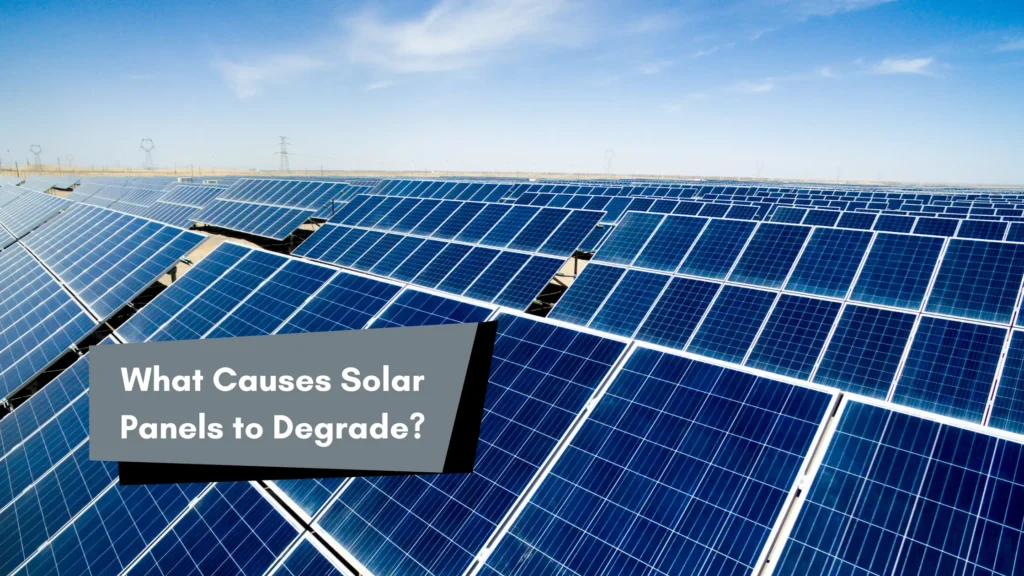
Here are several factors that cause solar panels to degrade and contribute to this gradual decline in performance. Knowing them can help you understand how to manage their effects.
Light-Induced Degradation (LID)
This is an initial, small drop in efficiency that happens in the first few hours of exposure to sunlight. A panel can lose 1% to 3% of its efficiency right at the start, after which the degradation rate stabilizes. This is a one-time event and is considered in the panel’s rated power.
Thermal Cycling
Solar panels expand when hot and contract when cold. This daily cycle, known as thermal cycling, creates mechanical stress over the years, which can lead to tiny microcracks in the silicon solar cells. These microcracks can impede the flow of electricity, reducing output.
Environmental Factors
UV radiation can slowly break down materials. The extreme weather, like hailstorms, heavy snow loads, and strong winds, can cause physical damage. Humidity can also lead to corrosion of the internal electrical connections. Check out the solar panels’ performance in Scottish weather.
Potential-Induced Degradation (PID)
This occurs when a voltage difference develops between the solar cells and other components of the panel, like the frame. This imbalance lets power leak away, and ultimately reduces performance if not addressed.
Normal Degradation Rates & What 10 Years Looks Like
Most modern solar panels degrade at a rate of around 0.5% per year. The high-quality panels may degrade at a rate as low as 0.3-0.4% annually. Budget panels or harsh climates can push that closer to 0.8%. The real numbers are like:
- At 0.5% each year, your panels still operate at about 95% of their original output after 10 years.
- Premium modules can deliver 96–97%.
- Lower-grade panels adjust degradation at 92%.
So after a full decade, you are usually looking at only a 3–8% drop, which is not noticeable in daily use.
How Much Does Your Solar System Actually Save You?
With a natural degradation, your system still performs well and saves you on electricity costs. A system that originally produced 7000 kWh per year might still deliver 6600–6900 kWh after 10 years.
Due to the gradual drop, your payback period rarely changes. And as grid prices rise, the relative value of each unit of solar energy increases.
Most manufacturers even back this up with warranties guaranteeing 80–85% performance at Year 25. In real-world scenarios, many panels outperform those promises. See what Reddit people say!
How to Keep Solar Degradation Low?
If you want your panels performing strongly well past the 10-year mark, follow the given tips:
- Always choose reputable, high-efficiency panels with low degradation ratings.
- Use certified, experienced installers like Renew-able Solutions because the installation is important, like the worth of the hardware.
- Make a habit of cleaning to prevent dust and debris from blocking sunlight.
- Keep an eye on shading changes as trees grow.
- Review your inverter or monitoring app for sudden drops in output.
The Future of Your Solar Investment
After a decade, your solar panels are far from the end of their life. With an expected lifespan of 25 to 30 years or more, your system has many productive years ahead.
Even after 25 years, a system operating at 80-85% efficiency is still generating significant free electricity from the sun.
Ongoing research into new technologies like Passivated Emitter and Rear Contact (PERC) cells and advanced backsheets aims to make future panels even more resilient and push degradation rates lower and extend operational lifetimes further.
I hope you now understand the solar degradation. You can monitor your system’s health, maintain it properly, and ensure that your clean energy investment will continue to provide returns well into the future!