Solar panel degradation is one factor to consider when estimating how much electricity your system will produce after ten years. Understanding it helps you compare warranties, interpret performance and plan for the long term.
Solar panels can keep producing electricity well beyond their first decade. Their remaining output depends on the module, installation and operating conditions. A useful estimate starts with the specific manufacturer’s performance warranty rather than a single percentage for every system.
This guide explains solar panel degradation, the factors that affect output and how to interpret an illustrative ten-year calculation.
What Is Solar Panel Degradation?
Solar panel degradation is the gradual reduction in a panel’s power output over time under comparable conditions. It differs from temporary losses caused by weather, shading or dirt.
However, thanks to durable materials and advanced manufacturing, Solar panels are expected to last 25 years, and in many cases, have lasted much longer.
A degradation rate describes how a panel’s power output changes over time under comparable conditions. This is different from conversion efficiency: retaining 95% of original output does not mean converting 95% of sunlight into electricity.
Compare the first-year allowance and subsequent annual decline in the warranty for the exact module offered. Warranty limits and measured degradation are not interchangeable.
What Causes Solar Panel Degradation?
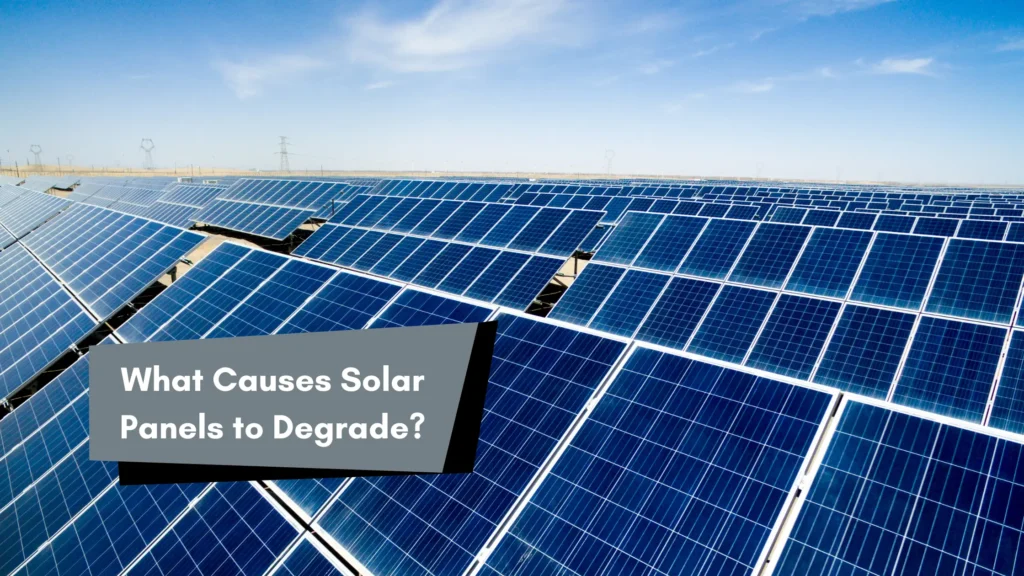
Here are several factors that cause solar panels to degrade and contribute to this gradual decline in performance. Knowing them can help you understand how to manage their effects.
Light-Induced Degradation (LID)
Light-induced degradation is an early change in output after exposure to sunlight. Its extent depends on the cell technology and module design; check how the manufacturer accounts for it in the product’s performance warranty.
Thermal Cycling
Solar panels expand when hot and contract when cold. This daily cycle, known as thermal cycling, creates mechanical stress over the years, which can lead to tiny microcracks in the silicon solar cells. These microcracks can impede the flow of electricity, reducing output.
Environmental Factors
UV radiation can slowly break down materials. The extreme weather, like hailstorms, heavy snow loads, and strong winds, can cause physical damage. Humidity can also lead to corrosion of the internal electrical connections. Check out the solar panels’ performance in Scottish weather.
Potential-Induced Degradation (PID)
This occurs when a voltage difference develops between the solar cells and other components of the panel, like the frame. This imbalance lets power leak away, and ultimately reduces performance if not addressed.
Solar Panel Degradation Rates: A Ten-Year Illustration
For an illustrative constant annual decline, remaining output after 10 years is calculated as (1 − annual rate)10. These examples are calculations, not predictions or warranty terms for a particular panel.
At 0.3% per year, approximately 97.0% remains; at 0.5%, approximately 95.1%; and at 0.8%, approximately 92.3%. Actual warranties may use a separate first-year allowance and a linear calculation.
How Much Does Your Solar System Actually Save You?
Using the illustrative 0.5% annual decline above, an initial annual yield of 7,000kWh becomes approximately 6,658kWh after ten annual reductions, if all other conditions stay the same. Real annual generation also changes with weather, shading, soiling and equipment availability.
Include degradation in savings and payback estimates. The financial result also depends on installation costs, self-consumption, export payments, electricity prices and any maintenance or replacement costs.
Check the exact module’s product and performance warranties, including the final guaranteed output, exclusions and claim procedure. A performance warranty is not a guarantee of annual generation or bill savings.
How to Monitor Solar Panel Degradation and Performance
If you want your panels performing strongly well past the 10-year mark, follow the given tips:
- Always choose reputable, high-efficiency panels with low degradation ratings.
- Use certified, experienced installers like Renew-able Solutions because the installation is important, like the worth of the hardware.
- Follow the manufacturer’s maintenance guidance and arrange safe professional cleaning if soiling is affecting output.
- Keep an eye on shading changes as trees grow.
- Review your inverter or monitoring app for sudden drops in output.
The Future of Your Solar Investment
After a decade, your solar panels are far from the end of their life. With an expected lifespan of 25 to 30 years or more, your system has many productive years ahead.
A panel that retains 85% of its original rated output can still be useful. Whether to retain or replace an older system depends on its condition, measured performance and repair costs.
PERC is an established cell technology. Fraunhofer ISE’s Photovoltaics Report describes the market shift towards n-type TOPCon and heterojunction modules. A technology label alone does not establish a panel’s lifetime or degradation rate: compare the manufacturer’s test evidence and warranty for the actual product.
I hope you now understand the solar degradation. You can monitor your system’s health, maintain it properly, and ensure that your clean energy investment will continue to provide returns well into the future!