Choosing a charger for a home with solar and batteries? Our EV charger comparison explains the energy controls, pros, cons and installation extras across six popular options.
You plug in the car, Octopus finds a cheap charging slot, and your home battery starts falling. Sound familiar? We regularly hear from customers who expected their EV to use low-cost grid electricity, only to discover that the battery they saved for the house is helping charge the car.
The short answer: a home battery in self-consumption mode may see the EV charger as another household load and discharge to meet it. On suitable installations, Renew-Able Solutions can alter the metered supply arrangement and battery-control CT positioning so the inverter no longer responds to the EV demand. Our charge is £125 for single phase or £300 for three phase, and the service is available even if another company installed your system.
By Alan Valente for Renew-Able Solutions · Serving Edinburgh, East Lothian and wider Central and East Scotland · Technical and tariff sources checked 9 September 2026.
Why does Intelligent Octopus Go sometimes empty your home battery?
Your charger and your home battery can be doing exactly what their individual settings ask. Octopus decides when to charge the car. Meanwhile, the inverter tries to reduce grid imports by supplying demand from stored energy. Unless the controls are coordinated, the battery does not know that this particular demand is an EV charging session you would prefer the grid to supply.
A CT clamp (current transformer) is a sensor used to measure electrical current. The inverter uses its CT or energy-meter readings to decide how much power to charge or discharge. If that measurement includes the EV charger, the inverter may respond when the car starts charging.
That can be especially noticeable when Octopus schedules a session outwith the usual 23:30–05:30 home off-peak window, while your battery is in its normal daytime discharge mode. It can also happen overnight if the battery settings still allow discharge. The behaviour depends on the system; it does not affect every installation. Octopus itself explains this home-battery interaction, and Ohme advises preventing battery discharge during EV charging.
A cheap tariff slot does not tell the battery to stand down
The tariff controls the price of imported electricity; it does not, by itself, choose the source of the electricity flowing into your car.
An illustrative example: suppose the car draws 7 kW and the house uses 1 kW, with no solar generation. If the inverter supplies 3 kW from the battery, the grid provides the remaining 5 kW. After an hour, roughly 3 kWh has left the battery’s AC output—even though you intended to preserve that energy for the home. Actual battery depletion also includes conversion losses.
Under Octopus’s current published charging guidance, the house has a 23:30–05:30 off-peak window and eligible smart EV charging has a six-hour daily allowance, measured midday to midday. Eligible additional smart-charge half-hours can also receive the home off-peak rate. Boost charging and charging beyond the allowance are treated differently. Check your account’s current terms, integration and Charge Cap availability; do not assume every daytime charge is cheap. Read Octopus’s smart-charging and Charge Cap explanation.
Our solution: make the inverter “blind” to the EV charger
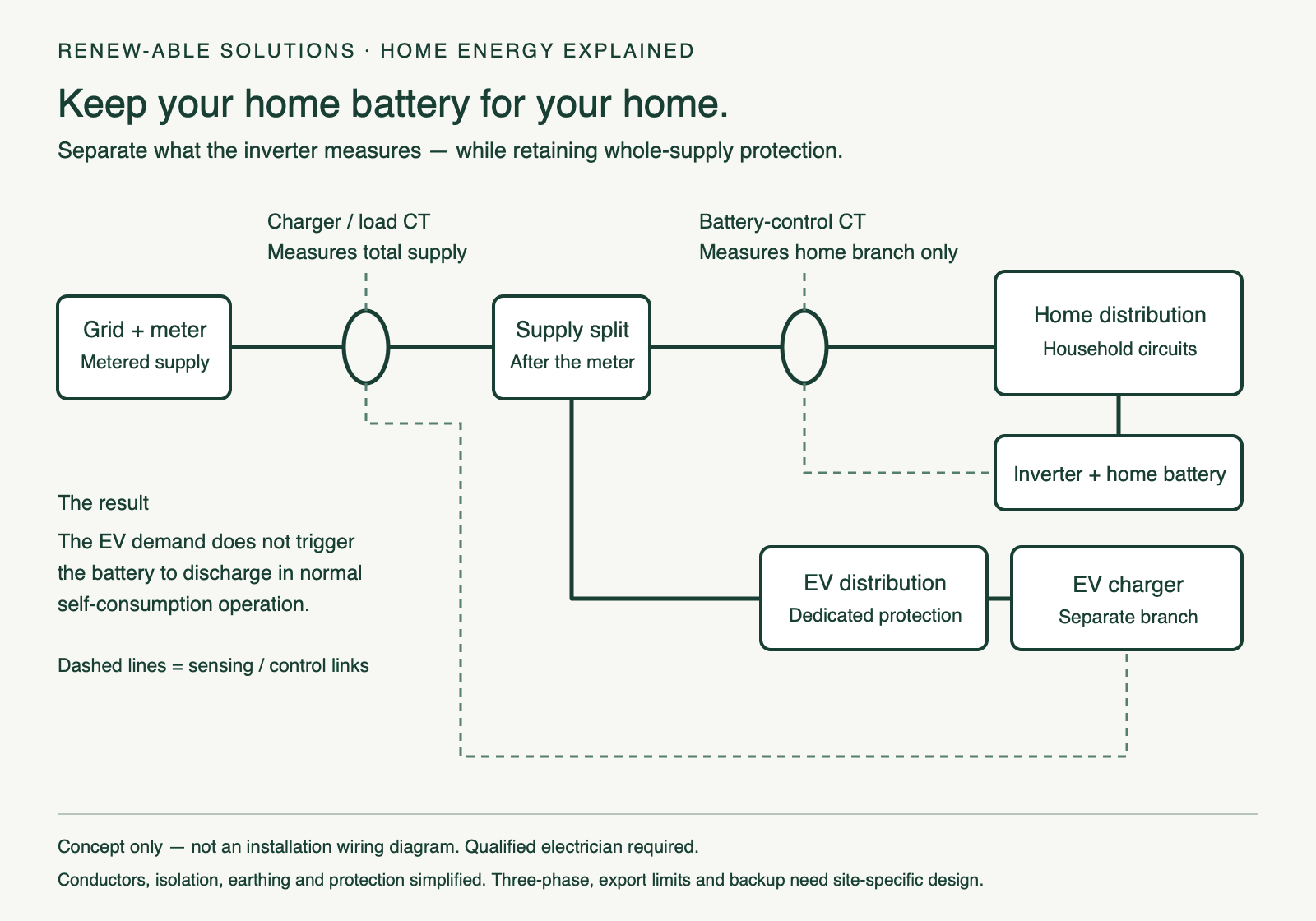
For a suitable installation, we rearrange the customer-side meter tails and distribution so the EV charger has a separate branch from the home. We position the battery-control CT so it measures the home branch while excluding EV demand. In normal self-consumption operation, the inverter then responds to the house without trying to cover the car’s charging load.
This is the principle described in myenergi’s guidance on separate supplies and CT positioning. The charger’s own grid/load-management sensor must still see the total supply where required. We do not simply move every clamp or bypass the electricity meter.
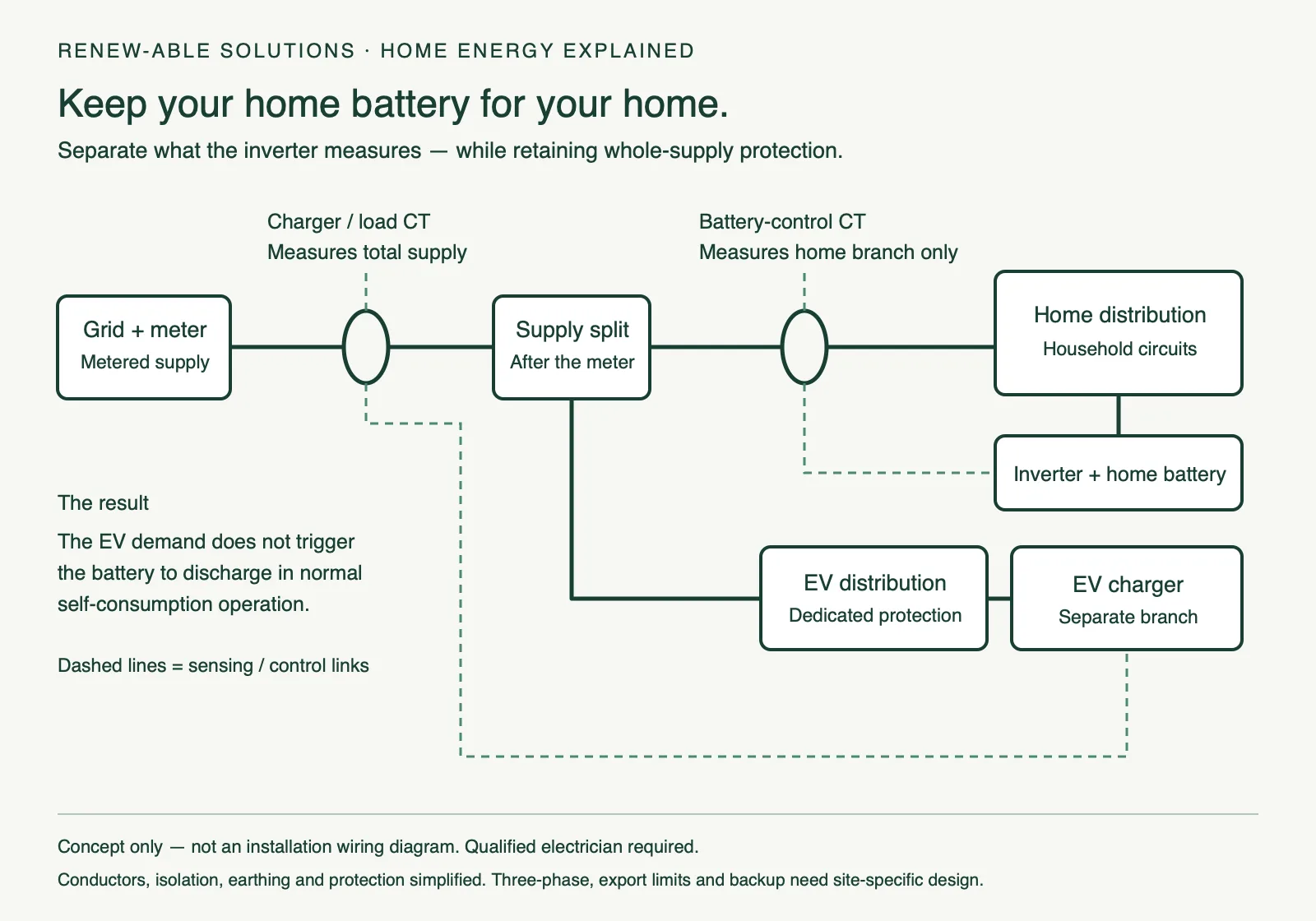
This is a conceptual line drawing, not a DIY wiring guide. Meter tails can carry substantial current. A qualified electrician must assess and carry out the work, arrange safe isolation and test the finished installation. Actual isolation, earthing, protection and conductors are simplified in the illustration.
Suitability matters. We check the inverter and charger instructions, single- or three-phase measurement, supply capacity, any export-limiting controls and backup arrangements. A sensor used for a required whole-site export or import limit cannot simply lose sight of the EV branch. Solar-diversion behaviour, monitoring figures and any forced battery-export mode also need checking. Some systems are better served by a manufacturer-supported control solution.
What does the battery-drain fix cost?
| Electricity supply | Service charge |
|---|---|
| Single phase | £125 |
| Three phase | £300 |
These are our charges for the CT and supply-arrangement fix described above. We check your installation and confirm the agreed scope, VAT treatment, total payable and any additional work before booking.
You do not need to be an existing Renew-Able customer. If another installer fitted your solar panels, battery or EV charger, we can still assess the setup and help. We serve Edinburgh, East Lothian and wider Central and East Scotland; contact us to confirm coverage for your address.
Other owners have encountered the same problem
These independent YouTube videos offer useful explanations and real-world context. They are not Renew-Able customer testimonials or endorsements of our service. Their older app screens and tariff information may differ from today’s arrangements.
Tomas McGuinness — How I stopped my EV charger from draining my house battery
Tomas describes his own zappi and home-battery problem, explains the CT readings and reports the result after changing the wiring arrangement. His chapter at 00:46 introduces the problem; 17:02 covers the outcome. Published 30 June 2023.
Watch Tomas McGuinness on YouTube
Gary Does Solar — How to Stop your Home Battery from Draining into your EV
Gary explores the same battery-drain problem with Intelligent Octopus Go and discusses a Home Assistant approach. Start at 01:46 for the problem or 04:32 for the automation option. Published 8 February 2025.
Watch Gary Does Solar on YouTube
Prefer no wiring changes? Charge the car when you charge the home battery
Yes—matching the EV charging period to the home battery’s charging period can be a practical alternative. For example, a suitable setup might charge both during 23:30–05:30. But the essential setting is to prevent the home battery discharging for the entire EV session. A battery that reaches 100% early may resume powering loads unless its hold-charge or no-discharge settings prevent it.
Check that both schedules use the correct local time and daylight-saving settings, and that the supply can support the simultaneous loads with the charger’s load management working correctly. After setup, check the battery power reading when the car starts and again after the battery becomes full. Ohme’s battery guidance recommends a hold-charge or no-discharge approach.
With Intelligent Octopus Go, a fixed timer can conflict with Octopus’s dynamic charging instructions and may miss additional cheap slots or your requested vehicle charge target. Do not permanently disable smart charging as a blanket workaround: Octopus’s tariff terms require an active compatible integration and continued smart-charging use. Ask about a supported way to coordinate the battery with smart sessions. If you want a strictly fixed charging window, check whether a fixed-window EV tariff is a better fit.
A compatible automation can instead pause battery discharge whenever smart EV charging takes place, including extra slots. This depends on the equipment and integrations remaining reliable. We can help you compare the wiring approach with the controls your system actually supports.
Frequently asked questions
Will every EV charger drain a home battery?
No. It depends on the wiring, inverter operating mode, CT or meter arrangement, available battery energy and charging controls. The charger requesting power does not mean that power must come from the grid.
Will moving a CT clamp change my electricity bill readings?
The supplier’s electricity meter continues to measure grid imports and exports. The purpose of the alteration is to change the inverter’s control measurement. It does not bypass the meter or create free electricity.
Will my battery still power the house?
On a suitable system, yes: the inverter continues responding to household demand while excluding the separate EV branch from its self-consumption measurement. Solar export, forced discharge and backup behaviour need checking for the particular installation.
Can you fix a system installed by another company?
Yes. Renew-Able Solutions offers this service to existing customers and customers of other installers in Edinburgh, East Lothian and the wider Central and East Scotland area, subject to a suitability and location check.
How much does the EV charger battery-drain fix cost?
Renew-Able Solutions charges £125 for single-phase supplies and £300 for three-phase supplies for the CT and supply-arrangement fix described here. We check suitability and confirm the scope, total payable and any additional work before booking.
Stop the car taking the energy you saved for the house
Tell us your EV charger model, inverter and battery model, whether the supply is single or three phase, and when you notice the battery discharging. Screenshots from your energy apps can help us understand the behaviour. You do not need to open any electrical enclosures.
Request an assessment of EV charging and battery interaction, call 0131 210 0405 or email hello@renew-able.co.uk. We will assess suitability and confirm the work before booking.
Explore our home battery storage services, EV charger installations, Intelligent Octopus Go guide and compatible EV charger comparison.