A solar quote with a long warranty can feel reassuring. Yet a “25-year warranty” headline does not necessarily cover every component, every fault or the cost of reaching the roof. Solar panel warranties need reading as several separate promises.
Compare product cover, performance cover, inverter cover and installation workmanship separately. Then check the claim process and any labour, transport or access exclusions. The longest number is only one part of the protection.
For homeowners in Edinburgh and East Lothian, this matters particularly where roof access could require scaffolding or other specialist arrangements.
Want advice for your home? Call 0131 210 0405 or send an enquiry to Renew-Able Solutions.
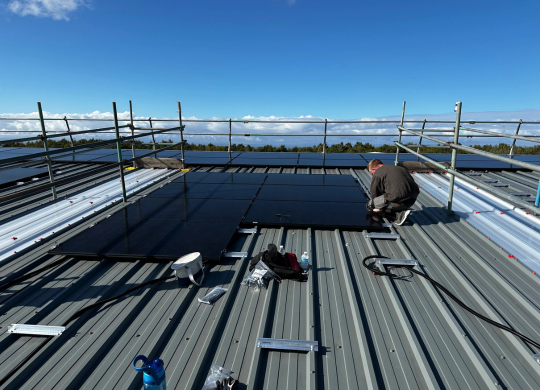
Solar panel warranties: identify the different cover
| Type | What to look for | What not to assume |
|---|---|---|
| Panel product warranty | Defined manufacturing or material defects | That every cause of damage qualifies |
| Panel performance warranty | A stated output threshold under specified conditions | That it guarantees your annual electricity bill |
| Inverter or battery warranty | Its own term, conditions and limits | That panel cover applies to other equipment |
| Workmanship warranty | Installation work and the party responsible | That it is the same as a manufacturer warranty |
Ask for the actual documents for the exact models on the quotation. A general brochure for a product family may not describe the version you are buying.
Why a performance warranty is not a savings guarantee
A panel performance warranty normally concerns the module’s power output against a defined standard over time. Your home’s annual generation also depends on sunlight, roof direction, shading and the rest of the system.
Likewise, your bill saving depends on consumption and tariffs. A household that changes its routine may save less without any panel fault at all.
Our roof orientation guide explains one of those design variables. Keep the original generation estimate and its assumptions alongside the warranty, so you can distinguish a design question from an equipment claim.
Solar panel warranties: who pays for fault-finding and access?
Consider a hypothetical faulty panel ten years after installation. A manufacturer might offer a repair, replacement or another remedy under its terms. That still leaves practical questions about diagnosis and roof access.
- Who arranges the initial inspection and establishes the cause?
- Does cover include removal and refitting labour?
- Who pays for transport, scaffolding or other access equipment?
- What remedy applies if the original model is no longer available?
- Are there claim deadlines or evidence requirements?
Do not assume exclusions apply to every warranty. Equally, do not assume a long term means all those costs are included. The written terms should settle the point.
Workmanship and insurance protection deserve their own check
Installation quality affects cable routes, fixings, roof details and electrical connections. A manufacturer’s equipment warranty is not a substitute for a clear workmanship promise from the installer.
An insurance-backed guarantee can provide protection in defined circumstances if an installer ceases trading. However, its scope, period and claim requirements still matter. Request the actual policy or certificate where such protection forms part of the contract.
RECC’s consumer guidance on deposit and workmanship protection explains its requirements for member businesses. It does not confirm that a particular household has a policy; check your own documents.
Do batteries have different conditions?
They can. A battery warranty may refer to retained capacity, elapsed time, energy throughput or permitted operating conditions. Read the relevant model’s terms rather than applying the panel warranty to the whole installation.
Also check registration, internet connectivity, software and servicing conditions where specified. If your plan includes frequent tariff charging, ask whether that intended use fits the warranty.
Our inverter selection guide helps you compare the equipment itself. The support arrangement is another part of that decision.
Make the paperwork useful at handover
Create one folder containing the final invoice, equipment models, serial numbers, commissioning records and warranties. Include registration confirmations and the installer’s contact details.
Keep the original design estimate too. If monitoring later shows a change, export the relevant data before an app account or device is replaced. Clear dates and readings make a support conversation much easier.
For routine care, see our solar monitoring and maintenance guide. Follow the equipment instructions, and use a qualified professional for electrical or roof work.
Compare solar panel warranties across two quotes
Put the documents side by side and compare the same headings: equipment, term, remedy, labour, access, exclusions and claim contact. Note any unanswered point and ask for it in writing.
A clear, shorter promise can be easier to understand than a sweeping headline with uncertain exclusions. However, do not judge protection by term alone in either direction.
Finally, ask what happens if you sell the home. Some cover may transfer subject to conditions. Keeping the records organised helps both the next owner and any future installer understand the system.
Talk through your next step
Bring us the warranty sections of your solar proposal. We can explain the equipment and workmanship cover included in our own quotation.
Explore our solar service, call 0131 210 0405 or submit an enquiry. Renew-Able Solutions serves Edinburgh, East Lothian and surrounding areas; tell us your postcode so we can confirm suitability and coverage.
Technical sources and examples checked on 3 October 2026. Illustrative figures are not quotations or guaranteed savings.