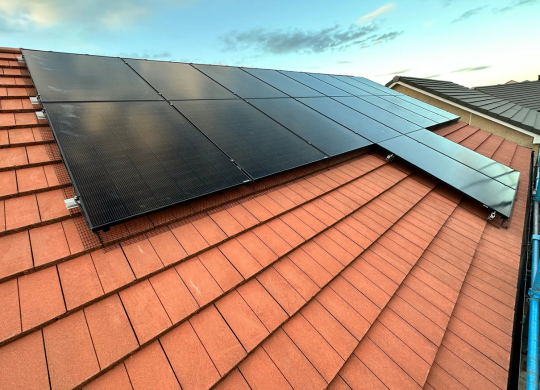
AIKO 485W all-black solar panels combine a high power rating with a discreet roof appearance. We use them where their specification, layout and overall system value suit the property. The right recommendation still depends on the roof, inverter, shading and the electricity the household can use.
Technical reference checked 27 September 2026. The figures below refer specifically to the AIKO NEOSTAR 3S54 AIKO-A485-MCE54Mb in the linked manufacturer datasheet. AIKO sells several 485 W variants: the exact model and applicable UK warranty must match your quotation.
Photo note: the roof photograph is illustrative and is not evidence of a particular AIKO model.
What does the 485 W rating tell you?
The rating is the panel’s maximum power under standard test conditions. It helps compare products, but is not a promise of continuous output on your roof. Ten panels give a rated array size of 4.85 kWp; twelve give 5.82 kWp. Annual generation is a different measurement, expressed in kWh.
| Specification | Manufacturer’s stated value |
|---|---|
| Rated power at standard test conditions | 485 W |
| Module efficiency | 24.3% |
| Dimensions | 1,762 × 1,134 × 30 mm |
| Power temperature coefficient | −0.26% per °C |
| Published warranty periods | 25-year product / 30-year performance |
| Published performance curve | Up to 1% first-year degradation; up to 0.35% a year thereafter |
Source: AIKO NEOSTAR 3S54 460–485 W datasheet, version V1.5. Warranty terms, exclusions and claim procedures apply. A performance warranty concerns module output under defined conditions; it does not guarantee your annual generation, savings or a free whole-system replacement.
Why this can be useful on a limited roof
Roof space is often the binding constraint. For illustration, ten 485 W panels total 4.85 kWp, compared with 4.40 kWp for ten 440 W panels: around 10% more rated power from the same panel count. That comparison does not assume identical dimensions or imply 10% more annual generation. We still need to check the actual roof layout and each module’s size.
A neat rectangular array may fit a property better than a larger panel count spread around awkward obstructions. The available area must also allow the mounting system’s required clearances and safe access. The final layout is a design exercise, not simply a calculation from the roof’s total square metres.
Why the all-black design appeals to homeowners
AIKO’s back-contact design moves the cell’s electrical contacts to the rear, helping create a less interrupted front appearance. For homeowners comparing a visible street-facing array, the all-black finish can be an important part of the decision. Colour and appearance do not remove any planning or listed-building requirements.
How will they perform in Scottish weather?
Solar output depends on light reaching the cells. Clouds, chimney shadows, roof direction and short winter days all matter. A high-efficiency panel can make good use of a suitable roof, but no panel turns a heavily shaded site into an ideal one. Edinburgh and East Lothian installations should be assessed with local conditions and seasonal output in mind.
The negative temperature coefficient means output reduces as cell temperature rises above the test reference, all else equal. Using −0.26% per °C, a cell temperature 20°C above that reference implies about 5.2% less power from temperature alone. Cell temperature is not the same as the outdoor weather forecast, and this calculation is not a prediction of daily yield.
AIKO lists partial-shading optimisation among the panel’s features. We treat that as a reason to examine the design carefully, not permission to ignore shading. String arrangement, inverter input limits and any proposed optimisation equipment still need to work together.
Why we use them as part of a complete system
A good panel choice should support the whole solar PV design: useful roof capacity, an appearance the homeowner likes and compatibility with the selected inverter. We then consider whether battery storage or solar-aware EV charging helps use the generation effectively.
Price also matters. See our 2026 solar cost guide for budgeting examples, then compare quotations with the exact panel model, inverter, mounting system and installation scope shown.
Frequently asked questions
Will every 485 W AIKO panel have these specifications? No. Model families and datasheet revisions differ. Check the full product code instead of relying on wattage or a sales description alone.
Will these panels eliminate my electricity bill? No. Imported electricity and standing charges can remain, particularly in winter. Generation and savings should be modelled for your property.
Can you assess an existing array? Yes. Our solar and battery servicing service can help investigate performance concerns and identify appropriate checks.
Planning an energy upgrade in Edinburgh, East Lothian or Central and East Scotland? Tell Renew-Able Solutions about your property and we can assess the options around your energy use, equipment and budget.