Solar • Storage • Backup
Store your solar.
Keep your home running.
Sigenergy hybrid inverters bring solar panels and battery storage together. Choose a single-phase or three-phase system, add the right SigenStor batteries, and include a compatible Energy Gateway if you want backup power when the grid goes down.
Renew-Able Solutions designs and installs solar, battery storage and backup systems across Edinburgh, East Lothian and wider Central and East Scotland.
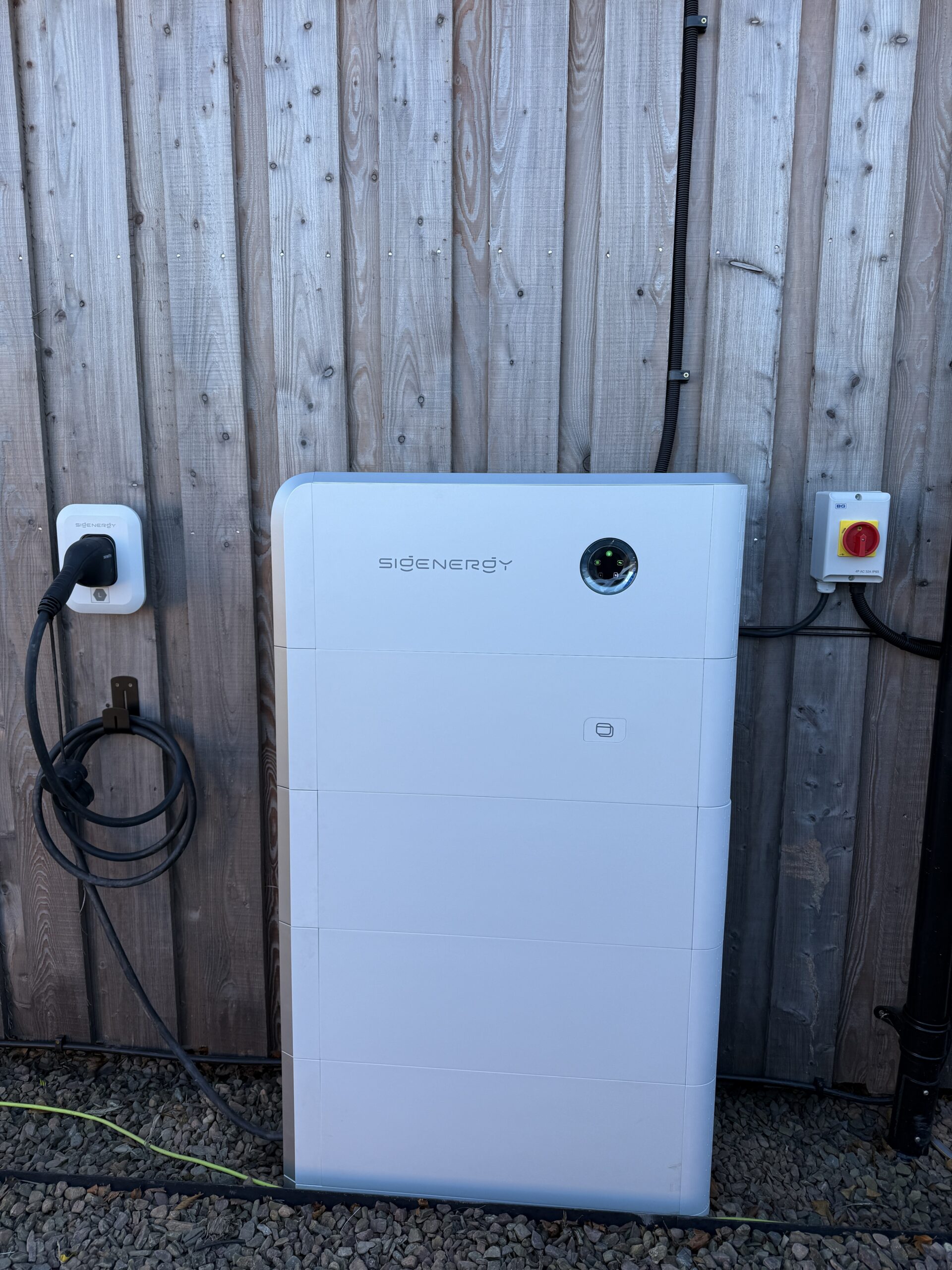
- Single-phase and three-phase inverter options suit different electricity supplies.
- Compatible SigenStor battery systems support 1–6 battery modules per controller.
- BAT 5.0, 6.0, 8.0 and 10.0 model names have different total and usable capacities.
- A correctly installed Gateway enables backup; the inverter and battery alone do not guarantee power during a cut.
By Alan Valente for Renew-Able Solutions · Specifications checked 9 September 2026. Exact UK model availability and the approved configuration are confirmed with your quotation.
Single-phase or three-phase: which Sigenergy inverter?
A hybrid inverter converts solar electricity for your home and manages the connection to battery storage. During normal operation, stored energy can supply the house when solar production falls. Start with our guide to how hybrid inverters work if you are new to the technology.
Most UK homes have a single-phase supply. Three-phase supplies are more common in larger properties, farms and commercial premises. We check your supply and the loads you want to run before choosing the equipment. Fitting a three-phase inverter does not turn a single-phase electricity supply into three phase.
There are two product layouts to distinguish: the slim, separate Sigen Hybrid SP2/TP2 inverter and the SigenStor Energy Controller (EC) used in the modular SigenStor system. Both offer hybrid functionality, but their power ranges and battery connection arrangements differ.
| Product family | Single phase | Three phase | Battery connection |
|---|---|---|---|
| Sigen Hybrid SP2 / TP2 | 2–6 kW range | 3–12 kW range | SigenStor BAT modules via a separate SigenStor BC battery controller |
| SigenStor Energy Controller | 3–12 kW range | 5–30 kW range | SigenStor BAT modules within the modular SigenStor arrangement |
These are the ranges in Sigenergy’s published international datasheets; individual ratings and regional versions vary. We specify the exact UK-approved model, solar-string design and any grid-connection or export requirements. Sources: Sigen Hybrid SP2/TP2 datasheet and SigenStor Energy Controller datasheet.
For a home with an existing solar inverter, the best route may involve retaining that equipment and adding storage. Our AC versus DC coupled battery guide explains the difference.
Which batteries can Sigenergy hybrid inverters use?
The supported battery family covered here is Sigenergy SigenStor BAT, using lithium iron phosphate (LFP) chemistry. The slim SP2/TP2 hybrids need the SigenStor BC between the inverter and battery stack. These systems should not be quoted as accepting any third-party battery simply because its voltage looks similar.
| Battery model | Total energy | Usable energy | Maximum charge / discharge power |
|---|---|---|---|
| BAT 5.0 | 5.38 kWh | 5.20 kWh | 2.5 kW |
| BAT 6.0 | 6.02 kWh | 5.84 kWh | 3.0 kW |
| BAT 8.0 | 8.06 kWh | 7.80 kWh | 4.0 kW |
| BAT 10.0 | 9.04 kWh | 8.76 kWh | 4.6 kW |
A BAT 10.0 is not 10 kWh of usable storage. Compare quotations using the usable capacity and exact model. BAT 5.0 and 8.0 are earlier modules; BAT 6.0 and 10.0 appear in newer documentation. Availability, hardware generation and expansion compatibility must be checked for your system.
Figures are manufacturer ratings under specified test conditions. Temperature, state of charge, ageing and conversion losses affect what reaches your appliances. Sources: BAT 5.0/8.0 product specifications, BAT 6.0/10.0 specifications and European warranty and usable-capacity schedule.
How many batteries can be in a stack?
One to six battery modules per controller is the published limit for the systems above. The inverter, battery controller, base and any EV charging module are separate components; they do not count as extra battery modules.
| Number of batteries | BAT 5.0 | BAT 6.0 | BAT 8.0 | BAT 10.0 |
|---|---|---|---|---|
| 1 | 5.20 kWh | 5.84 kWh | 7.80 kWh | 8.76 kWh |
| 2 | 10.40 kWh | 11.68 kWh | 15.60 kWh | 17.52 kWh |
| 3 | 15.60 kWh | 17.52 kWh | 23.40 kWh | 26.28 kWh |
| 4 | 20.80 kWh | 23.36 kWh | 31.20 kWh | 35.04 kWh |
| 5 | 26.00 kWh | 29.20 kWh | 39.00 kWh | 43.80 kWh |
| 6 | 31.20 kWh | 35.04 kWh | 46.80 kWh | 52.56 kWh |
For example, six BAT 10.0 modules provide 54.24 kWh total and 52.56 kWh usable at the manufacturer’s stated test conditions. The table is simple module-capacity arithmetic, not a prediction of electricity delivered to the house.
Sigenergy’s battery optimisers support expansion and mixing old and new batteries in approved configurations. We check the exact module combination, firmware, mounting limits and installation space before adding to an existing stack. More than six modules requires a separately designed multi-stack system with suitable controllers and Gateway capacity.
kWh tells you how much energy is stored; kW tells you how quickly it can be supplied. Adding batteries can increase available battery power, but it does not increase the inverter’s AC rating. A large inverter with too few batteries may also be limited by the batteries’ discharge power.
Which Sigenergy Energy Gateway do you need?
The Gateway manages the connection between the grid, the energy system and the backed-up circuits. Select it around your supply, number of inverters and backup plan. Model suffixes matter: HomePro SP and HomePro SP-F have different ratings.
| Gateway | Supply | Published connections / application |
|---|---|---|
| Home SP / Home TP | Single / three phase | One SigenStor; published nominal AC ratings of 12 kW / 30 kW respectively |
| HomePro SP | Single phase | Up to two SigenStor systems, with combined power limited to 12 kW |
| HomePro SP-F | Single phase | Up to two SigenStor systems; 100 A grid and backup ports |
| HomePro TP | Three phase | One SigenStor; published nominal AC rating of 30 kW |
| HomeMax SP 12K | Single phase | Up to three inverter connections; 100 A grid / backup rating, with individual port limits |
| HomeMax TP | Three phase | Up to two inverter connections; 76 A grid / backup rating, with individual port limits |
The HomeMax family also appears in existing installations and supplier ranges. We confirm current UK supply and the correct revision before specifying it. Larger commercial projects can use the C-series Gateway range. Sources: current Energy Gateway range and HomeMax SP 12K / TP datasheet.
A Gateway’s rating is not the amount of backup power your batteries will deliver. Actual output is limited by the connected inverter, battery power, available charge and circuit design. Supported smart ports can control selected heavy loads or integrate a compatible generator, depending on the model and configuration.
How can Sigenergy power your house in a power cut?
- The grid fails. The Gateway isolates the backup installation from the public supply.
- The system supplies the backup circuits. The compatible inverter and batteries keep those circuits running within their operating limits.
- Solar can help during daylight. Correctly configured solar connected to the backup-capable system can support loads and recharge the battery when generation is available.
- The grid returns. The system reconnects through its controlled restoration process.
This isolation is essential: ordinary grid-connected solar must stop feeding the public network during an outage. An existing separate solar inverter will not automatically continue operating in backup mode; compatibility and its position in the installation need checking.
Whole-home backup or essential circuits?
Whole-home backup can make the house’s circuits available during an outage, but you still need to keep combined demand within the system’s limits. Running an electric shower, hob, EV charger and heat pump together may exceed those limits.
Essential-circuit backup concentrates the stored energy on agreed loads such as lighting, refrigeration, the router and selected sockets or heating controls. Heavy loads can be excluded or managed to extend runtime. On three-phase systems, we check each phase’s loading and output limits as well as the total power.
Sigenergy specifies 0 ms load-side disruption under stated test conditions for compatible Gateway, inverter and battery combinations. Those conditions include inverter nominal power exceeding the connected load. This is not a blanket promise for every fault, appliance or installation. See the inverter datasheets linked above and our home battery power-cut guide.
How long will the battery last?
Runtime depends on the energy available when the cut starts and the average demand. As a simplified example, 10 kWh available to the loads ÷ 0.5 kW average demand = about 20 hours. At 2 kW average demand, the same energy lasts about five hours. Real results vary with reserve settings, losses, temperature, starting loads and solar generation.
We help you choose a backup reserve so some charge is held for outages. A higher reserve leaves less energy for everyday bill savings. A battery that has already discharged cannot provide the same protection as a charged one.
Already have Sigenergy?
For setup, settings and video help, open our Sigenergy app guide.
Sigenergy inverter and battery FAQs
Can I start with fewer batteries and add more later?
Yes, expansion is part of the SigenStor concept, subject to an approved configuration and available compatible modules. Plan the space, mounting and future demand at the first installation.
Do I need solar panels to have battery storage?
Battery storage can be designed to charge from the grid, including suitable time-of-use tariffs. The right equipment and operating mode depend on your installation. Read our guide to whether home battery storage is worthwhile.
Can I use my EV as another home battery?
That is a separate compatibility question. SigenStor can incorporate an optional DC EV charging module, but vehicle-to-home operation depends on the vehicle, supported software, approvals and system design. Read our Sigenergy vehicle-to-load and vehicle-to-home guide before relying on an EV for backup.
Will a larger battery run every appliance?
Extra capacity usually extends runtime. The inverter output, battery discharge rating and appliance starting demand determine what can run at once. We size energy and power separately.
Design your Sigenergy system with Renew-Able Solutions
Tell us about your electricity use, existing solar, EV or heat pump, and what you want to keep running during a power cut. We will assess the supply, inverter size, usable storage, Gateway and backup circuits together.
Explore our battery storage installations, solar PV services and solar and battery servicing.
Request a Sigenergy survey or call 0131 210 0405.