Yes—but only if the battery system has been specifically designed and installed to provide backup power. A standard grid-connected battery or solar PV system does not automatically keep a property running when the electricity network fails.
The inverter must be able to operate safely without the grid, the property must be electrically isolated from the network, and the intended backup circuits must be matched to the battery and inverter output. This article explains the choices for homeowners considering battery backup in Edinburgh, East Lothian and across Central and East Scotland.
Can my existing system provide backup?
Use this checklist to prepare for an installer assessment. A charged battery alone does not confirm that your house has backup power.
- Equipment: Find the inverter and battery make/model in your handover pack. Ask whether that exact combination supports EPS or backup operation.
- Installed backup hardware: Check the handover documents for a commissioned EPS output, backup gateway or changeover arrangement. A feature in a brochure does not mean it is installed.
- Supported circuits: Confirm which sockets or circuits are backed up. Ask whether a separate backup consumer unit or other approved arrangement is needed.
- Power and duration: List the appliances you want to run. The installer should check running power, starting surges, usable battery capacity and backup reserve.
- Solar during an outage: Ask whether your particular solar and battery configuration can recharge while operating independently of the grid.
- Commissioning evidence: Look for a recorded backup test and user instructions. Have a competent installer assess any missing information; do not move circuits or alter wiring yourself.
Find out what your system can back up
Send your postcode, inverter and battery make/model, and the essential appliances you want to keep running. We can assess a new or existing installation and explain the suitable options.
Explore our battery storage installation service for more information.
Why do ordinary solar panels switch off during a power cut?
Most grid-connected solar inverters are designed to shut down when they detect a network outage. This anti-islanding protection prevents electricity from being exported into grid cables while engineers may be working on them.
A home may therefore have solar panels and a charged battery but still lose power if the installation does not include a suitable Emergency Power Supply (EPS), backup gateway or changeover arrangement. Backup functionality is an electrical design choice, not a feature that should be assumed from the presence of a battery.
What is EPS?
EPS stands for Emergency Power Supply. It is an output or operating mode that allows a compatible inverter and battery to supply designated loads after the property has been safely disconnected from the grid.
Depending on the equipment and installation, EPS may power one dedicated socket, selected essential circuits or a larger part of the property. Some systems change over automatically; others use a manual changeover switch. The changeover time also varies by product and design.
EPS is not automatically the same as an uninterrupted power supply (UPS). Equipment that must not lose power, including critical medical or specialist IT equipment, should have a dedicated continuity plan based on its manufacturer’s requirements. A domestic battery should not be treated as the sole life-safety supply unless the complete arrangement has been professionally designed and approved for that purpose.
Three common home battery backup arrangements
1. Dedicated backup socket
A compatible inverter may supply a clearly labelled socket during a power cut. This can provide a straightforward way to run small essential loads such as a lamp, router, phone charger or other suitable appliance. The socket’s permitted load is governed by the inverter output and electrical protection.
2. Essential-circuit backup
Selected circuits are moved to a dedicated backup consumer unit. Typical choices might include lighting, refrigeration, internet equipment, heating controls and a limited number of sockets. The installer assesses both normal running power and short starting surges before agreeing which circuits can be supported.
3. Whole-home backup
A suitable gateway or changeover system can isolate the property and allow a compatible battery system to supply the main consumer unit. Whole-home backup does not mean that every appliance can be used simultaneously. The combined demand must remain within the inverter’s backup rating, and high-power loads may need to be switched off or automatically controlled.
Some properties are better served by essential-circuit backup because it protects the important loads while reducing the risk of the system being overloaded by an electric shower, oven, EV charger or heat pump.
Battery capacity and backup power are different
Two figures determine what a battery can do during a power cut:
| Measurement | What it tells you |
|---|---|
| Battery capacity (kWh) | How much usable energy the battery can store and therefore how long it may run the supported loads. |
| Backup output (kW) | How much power the system can supply at one time without overloading. |
For example, a battery with roughly 10kWh of usable energy supporting an average 1kW load might provide somewhat less than ten hours after allowing for conversion losses and the battery’s minimum state of charge. If several high-power appliances increase demand to 5kW, the available time falls sharply—and the inverter must also be capable of supplying that 5kW load.
Actual running time depends on the battery’s charge when the cut begins, the chosen backup reserve, temperature, battery condition, conversion losses and household demand.
What can a home battery normally run?
A correctly sized system can often support essential lower-power loads such as:
- lighting
- fridge and freezer circuits
- internet router and communications equipment
- heating controls and suitable pumps
- television, laptops and phone charging
- selected general-purpose sockets within the agreed load limit
High-power equipment requires much more care. Electric showers, immersion heaters, ovens, induction hobs, resistance heating, EV chargers and heat pumps may use a large proportion of—or exceed—the inverter’s backup output. Motors and compressors can also have a starting surge above their normal running demand.
Whole-home systems can support larger loads when designed for them, but sensible load management will always extend the available backup time.
Can solar panels recharge the battery during an outage?
Sometimes. The solar inverter, battery inverter and backup equipment must be designed to form and control a safe local electrical supply while disconnected from the grid. The available solar generation must then cover the live household demand before any surplus can recharge the battery.
Whether this works depends on the product and system configuration. It should not be assumed simply because solar panels and a battery are installed at the same property. Generation may also be reduced or temporarily stopped when the battery is full and the backed-up loads cannot use the surplus.
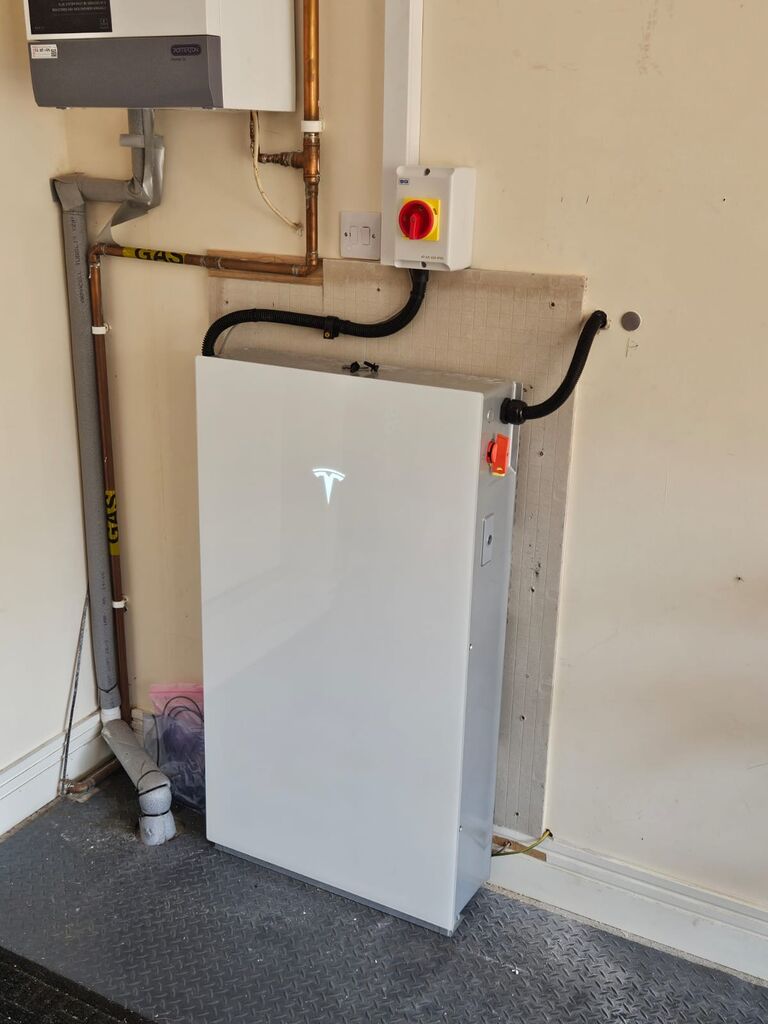
Tesla’s UK power-cut guidance, for example, explains that a correctly configured Powerwall system can coordinate solar generation while off-grid, but may reduce or stop the solar inverter when excess energy cannot be accepted.
Automatic or manual changeover?
An automatic system detects the grid failure, isolates the property and starts backup operation without the homeowner operating a switch. The interruption can range from effectively seamless to several seconds depending on the equipment.
A manual changeover arrangement requires the homeowner to follow an agreed switching procedure. It can be a practical option for some installations, particularly where immediate continuity is not essential, but it must be correctly interlocked so the backup supply cannot energise the public network.
What equipment may be required?
The exact design is property- and product-specific, but backup installations may include:
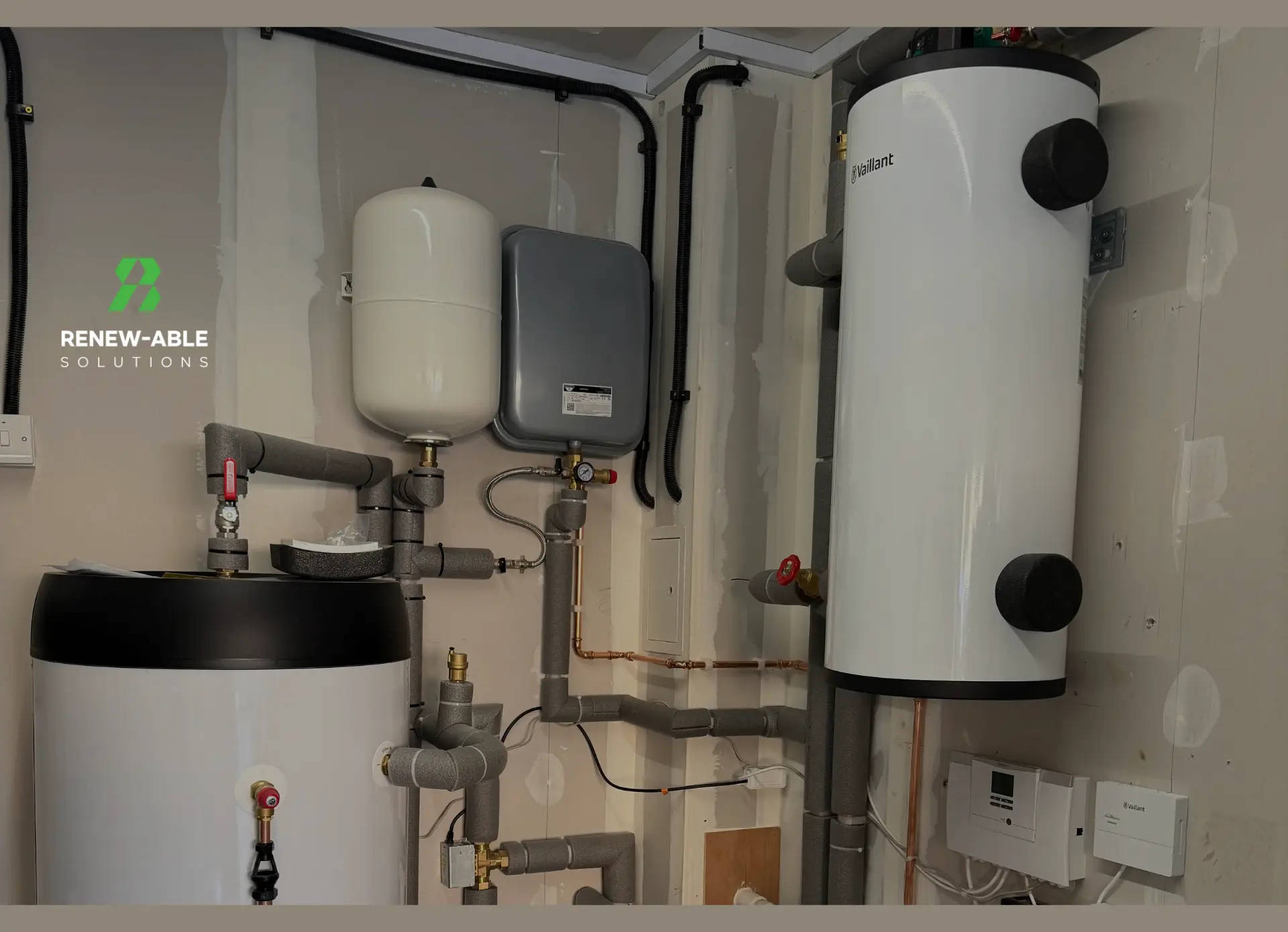
- a battery inverter with a suitable EPS or backup output
- an automatic gateway, contactor or mechanically interlocked manual changeover switch
- a separate consumer unit for essential circuits
- overcurrent and residual-current protection matched to the backup supply
- appropriate neutral switching and earthing arrangements
- load control where large appliances must be prevented from operating
- clear labelling, commissioning tests and customer instructions
A separate earth electrode may form part of some designs, but the correct arrangement depends on the supply, inverter and changeover method. Cable sizes and protective-device ratings must be calculated for the actual installation rather than selected from a generic recommendation.
Can backup be added to an existing battery?
Possibly. We first check the battery and inverter model, firmware, EPS capability, current wiring, consumer unit, earthing and manufacturer-approved accessories. Some systems can be upgraded with a gateway or dedicated backup circuit, while others cannot provide safe backup without replacing or adding equipment.
If you already have solar or battery storage, our solar PV and battery inspection service can help establish the condition and configuration of the existing installation before changes are proposed.
Current battery backup options
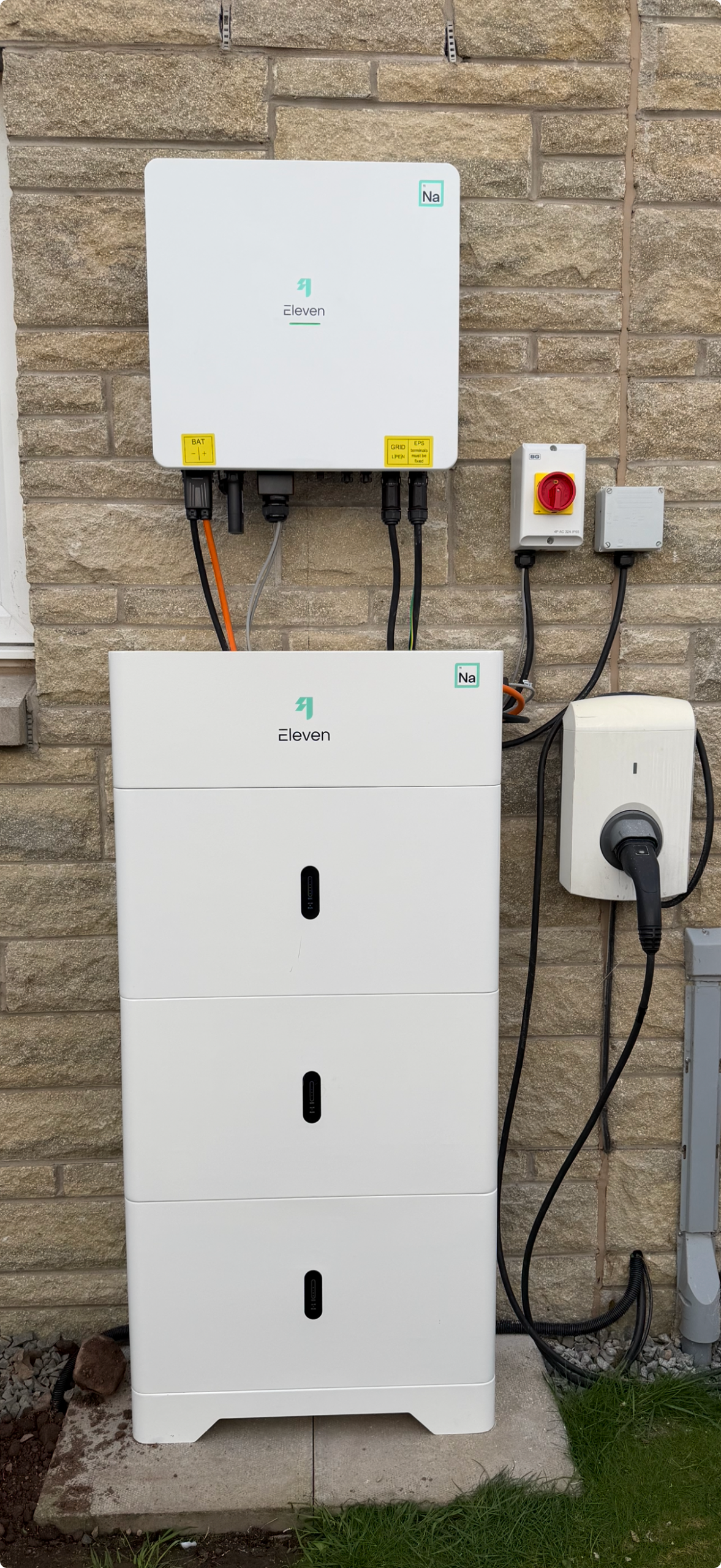
Renew-Able Solutions designs and installs battery storage systems from Sigenergy, Tesla, Fox ESS and Eleven Energy. Backup capability varies by model and configuration:
- Tesla Powerwall 3: a Backup Gateway detects outages, isolates the installation from the grid and enables automatic backup where the system has been designed for it.
- Sigenergy SigenStor: compatible Sigen Energy Gateway models can provide automatic backup, including whole-home arrangements where the property and system design allow.
- Fox ESS: compatible hybrid inverter systems provide model-specific EPS outputs that can be designed around selected circuits or a wider backup arrangement.
- Eleven Energy: its sodium-ion-compatible inverters include an EPS output for properly designed backup circuits, subject to the inverter rating and installation configuration. Read our Eleven Energy inverter and Galvani sodium battery guide for the model ranges, stack capacities and cold-weather performance.
The brand alone does not decide the result. We assess the specific model, power rating, battery capacity, number of phases and the property’s maximum demand before recommending an arrangement.
Safety, MCS and DNO considerations
Backup operation changes how an electrical installation behaves when the grid is absent. Isolation, earthing, fault protection, neutral switching and circuit selection must all work correctly in both grid-connected and backup modes.
The current MCS battery installation standard, MIS 3012:2025, covers the design and installation requirements for electrical energy storage systems. The battery inverter must also be included in the relevant DNO assessment, with G98, G99 and any G100 export-limitation requirements addressed where applicable.
Is home battery backup right for you?
Backup can be particularly useful for rural properties, homes with recurring outages, people working from home and households that want refrigeration, lighting, communications or heating controls to remain available.
Before specifying it, we establish:
- which circuits genuinely need backup
- the maximum simultaneous and starting loads
- the preferred backup duration
- whether solar should continue operating off-grid
- whether automatic changeover is required
- the battery reserve needed for unexpected outages
- future loads such as a heat pump or EV charger
Our survey can include a 3D internal LiDAR scan and drone survey where appropriate, helping us plan equipment positions, cable routes, backup circuits and the solar array before installation.
Battery backup in a completed installation
Our Milnathort battery installation combines 13.5 kWh of storage with EPS for designated circuits. The project account includes installation photographs and explains the role of the inverter, backup circuits and earthing arrangement. It is an example of a specified backup design, not a guarantee that every home battery can supply the whole house.
Frequently asked questions
Will every home battery work during a power cut?
No. The inverter must support backup operation and the required isolation, changeover, earthing, protection and backup circuits must be installed and commissioned.
How long will a home battery last in a power cut?
Runtime depends on usable battery capacity and the loads being powered. Reducing high-power consumption can extend backup from a few hours to much longer, but no duration should be promised without a load and energy assessment.
Can my heat pump run from the battery?
Potentially, but the inverter must support the heat pump’s running demand and starting characteristics, along with every other backed-up load. Battery capacity must also be sufficient for the intended operating time.
Can I charge an electric car during a power cut?
It may be technically possible with certain carefully designed systems, but EV charging is a high load and can rapidly drain a home battery. Most domestic backup plans prioritise essential household circuits instead.
Does backup switch over instantly?
Not always. Changeover time is product- and installation-specific. If uninterrupted operation is essential, the connected equipment’s tolerance and any dedicated UPS requirement must be assessed separately.
Arrange a home battery backup assessment
Renew-Able Solutions can assess a new or existing solar and battery installation and design suitable essential-circuit or whole-home backup where the equipment and property allow.
Contact us to arrange a battery backup survey, or learn more about our solar PV installations.